
Reading for Growth vs. Reading for Pleasure: Do You Need to Choose?
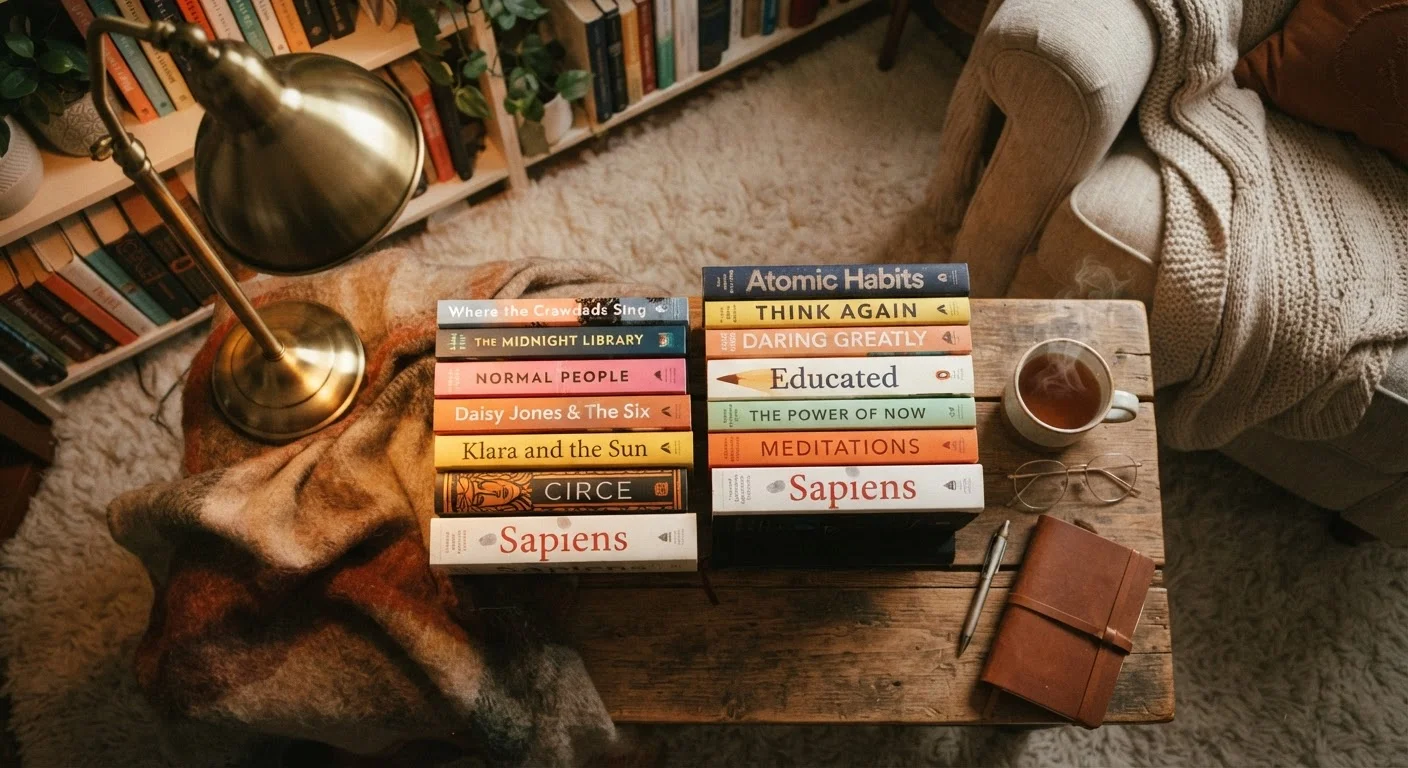
Photo credit: ExplorerGrid.com | Endless Grid Of Factual Content
In this article
Nonfiction deep dives and leisurely fiction serve different purposes. Explore how both types of reading contribute to a well-rounded lifelong learning practice.
Key Takeaways
- Reading for growth and reading for pleasure are not mutually exclusive activities.
- Fiction builds empathy and cognitive flexibility; nonfiction delivers frameworks and domain knowledge.
- A blended reading practice tends to be more sustainable and effective than choosing just one mode.
- How you read often matters as much as what you read for retaining information.
- Personal enjoyment is a legitimate and underrated driver of long-term learning habits.
Delivers structured, transferable knowledge and frameworks
Well-written nonfiction distills expertise that might take years to accumulate through direct experience alone, making it one of the most efficient ways to absorb domain knowledge.
Builds vocabulary in specific fields quickly
Reading within a discipline exposes you to the precise terminology experts use, which is essential for thinking, communicating, and learning further in that area.
Supports goal-directed skill development
When you have a clear learning objective, targeted reading lets you move deliberately toward that goal rather than accumulating knowledge passively.
Encourages critical analysis and evidence evaluation
Engaging with research-based nonfiction builds the habit of weighing sources, questioning claims, and distinguishing strong evidence from weak — skills that transfer broadly.
Can feel like an obligation, reducing reading frequency
When every book must be productive, reading becomes work. Readers who feel this way tend to read less overall, which undermines the cumulative benefits of any reading practice.
Pleasure reading offers fewer explicit knowledge frameworks
A novel rarely delivers a clear, extractable model you can immediately apply to a professional problem, which can frustrate readers with specific skill-building goals.
Entertainment-focused reading may discourage active retention strategies
Because pleasure reading prioritizes absorption over analysis, readers may not naturally pause to reflect, take notes, or connect ideas — habits that consolidate long-term learning.
Neither mode alone builds a complete intellectual diet
Exclusive devotion to either fiction or nonfiction leaves gaps: pure nonfiction readers may struggle with narrative empathy and creative thinking; exclusive fiction readers may lack systematic frameworks.
Why the Growth vs. Pleasure Debate Exists
The tension between reading for self-improvement and reading for enjoyment is largely a modern invention. Productivity culture has elevated nonfiction — business books, science writing, skill-building guides — as the "serious" choice, while fiction and casual reading are sometimes treated as indulgences to be earned after the real work is done.
This framing misrepresents how reading actually functions. Both modes activate complex cognitive processes, and neither is inherently superior. The more useful question is: what do I need from my reading right now, and how can I build a practice that sustains itself? See our guide to building a lasting learning habit for practical ways to make any reading practice stick over time.
What Reading for Growth Offers
Intentional, growth-oriented reading — typically nonfiction, textbooks, long-form journalism, or structured deep dives — gives readers direct access to frameworks, data, and expert thinking. When you finish a well-researched book on behavioral economics or a memoir from a domain expert, you leave with transferable mental models you can apply to decisions, work, and conversations.
Delivers structured, transferable knowledge and frameworks
Well-written nonfiction distills expertise that might take years to accumulate through direct experience alone, making it one of the most efficient ways to absorb domain knowledge.
Builds vocabulary in specific fields quickly
Reading within a discipline exposes you to the precise terminology experts use, which is essential for thinking, communicating, and learning further in that area.
Supports goal-directed skill development
When you have a clear learning objective, targeted reading lets you move deliberately toward that goal rather than accumulating knowledge passively.
Encourages critical analysis and evidence evaluation
Engaging with research-based nonfiction builds the habit of weighing sources, questioning claims, and distinguishing strong evidence from weak — skills that transfer broadly.
Growth reading works best when paired with active strategies: note-taking, summarizing chapters in your own words, or discussing ideas with others. Passive consumption of even excellent nonfiction tends to fade quickly. For a plain-language breakdown of the learning concepts behind retention — such as spaced repetition and elaborative interrogation — visit our glossary of key learning terms.
What Reading for Pleasure Offers
Pleasure reading — fiction, narrative nonfiction, poetry, or any text chosen purely for enjoyment — is not the learning "off switch" it is sometimes assumed to be. Decades of reading research suggest that fiction in particular strengthens what psychologists call theory of mind: the capacity to understand and anticipate other people's mental states, motivations, and emotions.
Can feel like an obligation, reducing reading frequency
When every book must be productive, reading becomes work. Readers who feel this way tend to read less overall, which undermines the cumulative benefits of any reading practice.
Pleasure reading offers fewer explicit knowledge frameworks
A novel rarely delivers a clear, extractable model you can immediately apply to a professional problem, which can frustrate readers with specific skill-building goals.
Entertainment-focused reading may discourage active retention strategies
Because pleasure reading prioritizes absorption over analysis, readers may not naturally pause to reflect, take notes, or connect ideas — habits that consolidate long-term learning.
Neither mode alone builds a complete intellectual diet
Exclusive devotion to either fiction or nonfiction leaves gaps: pure nonfiction readers may struggle with narrative empathy and creative thinking; exclusive fiction readers may lack systematic frameworks.
Beyond empathy, immersive reading builds vocabulary, exposes readers to varied sentence structures, and sustains the habit of reading itself. A reader who enjoys their books reads more often and more deeply than one who treats every page as a homework assignment. That consistency compounds over time in ways that occasional, effortful growth reading alone rarely matches.
~67%
Adults who read fiction report higher empathy scores
Multiple studies in social cognition research, including work published in the journal Science, associate literary fiction reading with stronger theory-of-mind performance.
6 minutes
Time reading may reduce stress levels measurably
A study at the University of Sussex found that as little as six minutes of reading reduced participants' stress levels by up to 68%, regardless of the material read.
Blending Both: A Practical Reading Diet
Most experienced readers naturally alternate between modes without thinking of it as a strategy. A useful way to conceptualize the balance is to treat growth reading as the main course and pleasure reading as both the appetizer and the reason you keep showing up to the table.
Practically, this might look like:
- Keeping one nonfiction title and one fiction title on the go simultaneously, switching based on energy and focus level.
- Using audiobooks for lighter or narrative-driven nonfiction during commutes, reserving deep reading for denser material.
- Allowing yourself to abandon books that feel like obligations — finishing a bad book rarely produces better outcomes than starting one you genuinely want to read.
This kind of self-directed flexibility mirrors the broader question of how to balance structured learning with autonomous exploration. Our article on structured courses vs. self-directed learning explores that tension in more depth.
Reading Format Matters Too
How you read — print, e-reader, or audio — can influence comprehension and enjoyment. Some research suggests print reading supports deeper processing for complex material, while audio formats work well for narrative-driven content. Experimenting with formats across different types of books can help you find what sustains your practice most reliably. There is no universally correct medium.
When One Mode Should Take Priority
There are legitimate contexts where tilting toward one type of reading makes sense. If you are preparing for a career change, a licensing exam, or a high-stakes project, concentrated growth reading in that domain can accelerate your ramp-up in ways that fiction cannot directly replicate. Conversely, during periods of burnout, grief, or high stress, the psychological restoration that comes from immersive fiction may actually be more productive than forcing yourself through a self-improvement book you can barely absorb.
The goal is awareness, not rigid rules. Knowing why you are reaching for a particular book — and what you hope to get from it — makes the practice more intentional whether the book is a thriller or a treatise on climate science. Reading alongside or discussing books with others can also deepen both modes; our piece on mentorship and peer learning covers how shared learning accelerates growth in ways solo study rarely achieves.

Author
Education & Learning Editorial Team
Education & Learning Editorial Team is the collective byline for our editorial team and contributor network. Articles published under this byline or an editorial pen name are researched, written, and reviewed according to our editorial standards for clarity, consistency, and independence before publication.
View all articles →