
Public University vs. Private College: Thinking Through the Right Fit
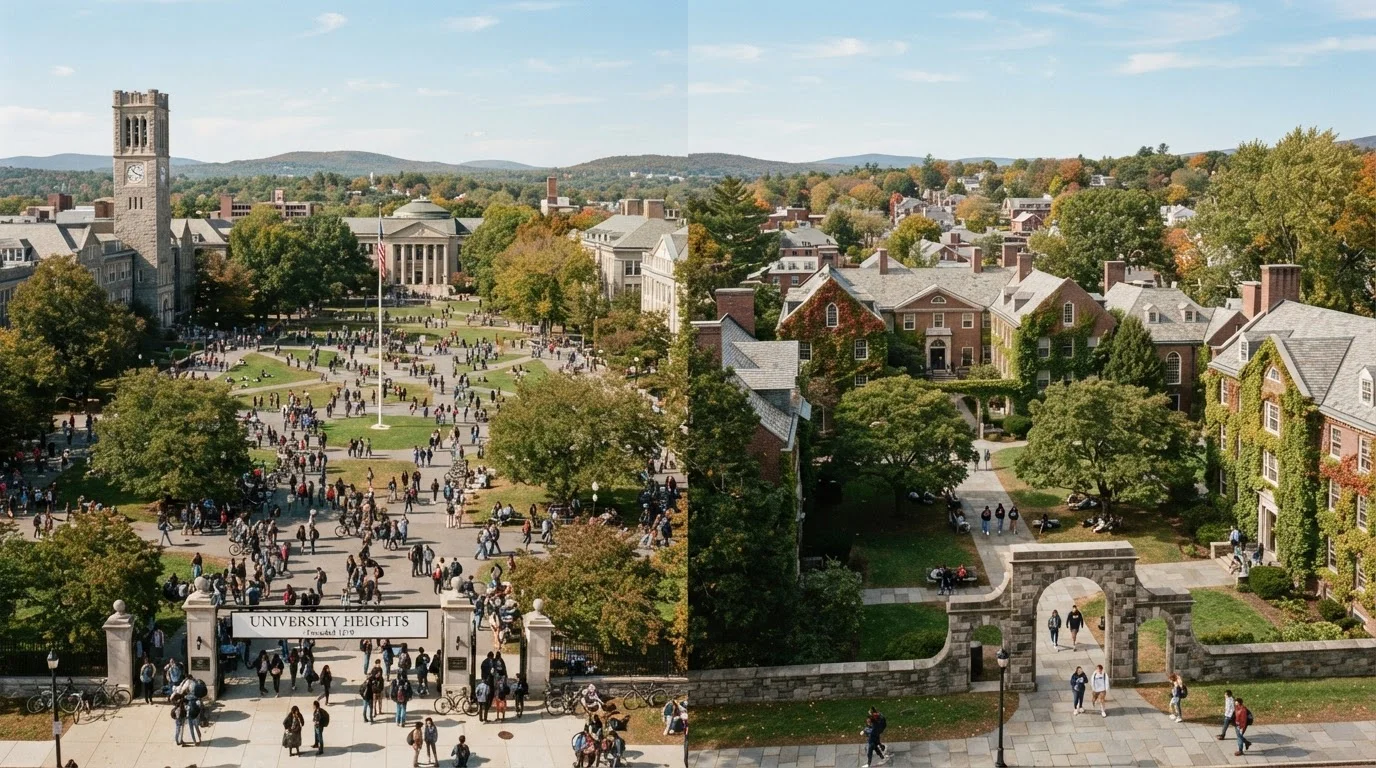
Photo credit: ExplorerGrid.com | Endless Grid Of Factual Content
In this article
Cost, class size, culture, and outcomes differ widely between public and private institutions. Here's a balanced look at both paths.
Key Takeaways
- Public universities typically cost less for in-state residents, but private colleges often offer substantial need-based aid that narrows the gap.
- Class size and faculty access tend to differ significantly between large public institutions and smaller private colleges.
- Campus culture, program breadth, and career networks vary widely within both categories — institution-specific research matters most.
- Neither path guarantees better outcomes; fit, engagement, and support resources drive student success at any institution.
Understanding the Core Differences
Public universities are funded primarily by state governments, which allows them to offer significantly reduced tuition to in-state residents. Private colleges and universities rely on tuition, endowments, and donations — and set their own pricing regardless of a student's state residency.
Beyond funding, the two models tend to produce different campus experiences. Public institutions often enroll tens of thousands of students, offering hundreds of academic programs, Division I athletics, and extensive research infrastructure. Private colleges — though not all are small — more commonly enroll a few thousand students and emphasize close faculty relationships and a defined institutional mission. Understanding these structural differences is the first step toward making a confident choice. For families still exploring the full landscape of higher education pathways, community college as a starting point is also worth considering.
The Real Cost Picture: Sticker Price vs. Net Price
The most common misconception in this comparison is that private colleges are always more expensive. Sticker price — the published tuition figure — frequently misleads families. Well-endowed private colleges often award substantial institutional grants that bring a family's actual out-of-pocket cost, known as net price, well below the advertised number.
Public universities, especially flagship state schools, have raised tuition steadily over recent decades. Out-of-state students at many public institutions now pay rates comparable to — or exceeding — those at some private colleges. The practical advice here: use each institution's net price calculator (federally required on all college websites) to generate a realistic estimate based on your family's income and assets before drawing conclusions from published tuition alone.
| Public University | Private College | |
|---|---|---|
| In-state tuition cost | Generally lower | Higher sticker price, but aid may offset |
| Net price after aid | Varies; less institutional aid typical | Can be competitive with strong aid packages |
| Typical enrollment size | Large (10,000–50,000+) | Often smaller (1,000–10,000) |
| Introductory class size | Often large lecture format | Typically smaller, faculty-led |
| Program variety | Very broad; hundreds of majors | Narrower; focused on core strengths |
| Research opportunities | Extensive at research universities | Available but smaller scale |
| Faculty access | More variable; grad assistants common | Generally more direct faculty contact |
Once you have net price figures in hand, factor in indirect costs: housing, meal plans, transportation, and textbooks. These vary considerably by institution and location and can shift the final comparison meaningfully.
Academic Environment and Student Experience
Class size is one of the most tangible differences students notice. At large public universities, introductory courses may seat hundreds of students in lecture halls, with smaller discussion sections led by graduate teaching assistants. Upper-division and graduate courses tend to be considerably smaller. Private colleges more often feature smaller class sizes across all years, with full faculty leading most courses — though this varies by institution.
Neither model is inherently superior. Students who are self-directed and comfortable navigating large systems often thrive in a public university's diverse, resource-rich environment. Students who prefer frequent faculty interaction and tightly knit cohorts may find a private college better supports their learning style. This connects to a broader question of how you learn best — structured versus self-directed learning approaches can inform how you evaluate either environment.
Career Outcomes and Alumni Networks
Graduates from both public and private institutions achieve strong career outcomes across industries. Research consistently shows that a student's major, internship experience, and engagement on campus predict earnings and career satisfaction more reliably than institutional type alone.
That said, certain private colleges — particularly those with large, active alumni networks — provide meaningful professional connections in specific industries or regions. Some public flagship universities carry equally powerful regional employer relationships and robust career centers. When evaluating this dimension, look specifically at each institution's career placement data, employer partnerships, and alumni presence in your field of interest rather than relying on general reputation.
For a structured approach to evaluating these factors before committing, see questions every family should ask before choosing a college.
Making Your Decision: A Practical Framework
Avoid the temptation to decide based on prestige or assumptions alone. A methodical comparison serves students and families far better. Start by identifying what matters most: program strength in your intended field, financial sustainability, campus size and culture, geographic location, and available support services.
Visit campuses — virtually or in person — and speak with current students, not just admissions staff. Request detailed financial aid award letters from every admitted institution before comparing them side by side. Understand the difference between grants (free money) and loans (debt), and calculate what total borrowing would mean for monthly repayments after graduation.
The goal is a decision you can commit to fully, in an environment where you're positioned to succeed. Neither a public university nor a private college is the universal right answer — the right fit is the institution that matches your academic goals, financial reality, and the environment in which you do your best work.
This article provides general educational information to help consumers make informed decisions. It is not a substitute for personalized guidance from a qualified school counselor or financial aid advisor.

Author
Education & Learning Editorial Team
Education & Learning Editorial Team is the collective byline for our editorial team and contributor network. Articles published under this byline or an editorial pen name are researched, written, and reviewed according to our editorial standards for clarity, consistency, and independence before publication.
View all articles →