
Reading a Nutrition Facts Label Without Getting Confused
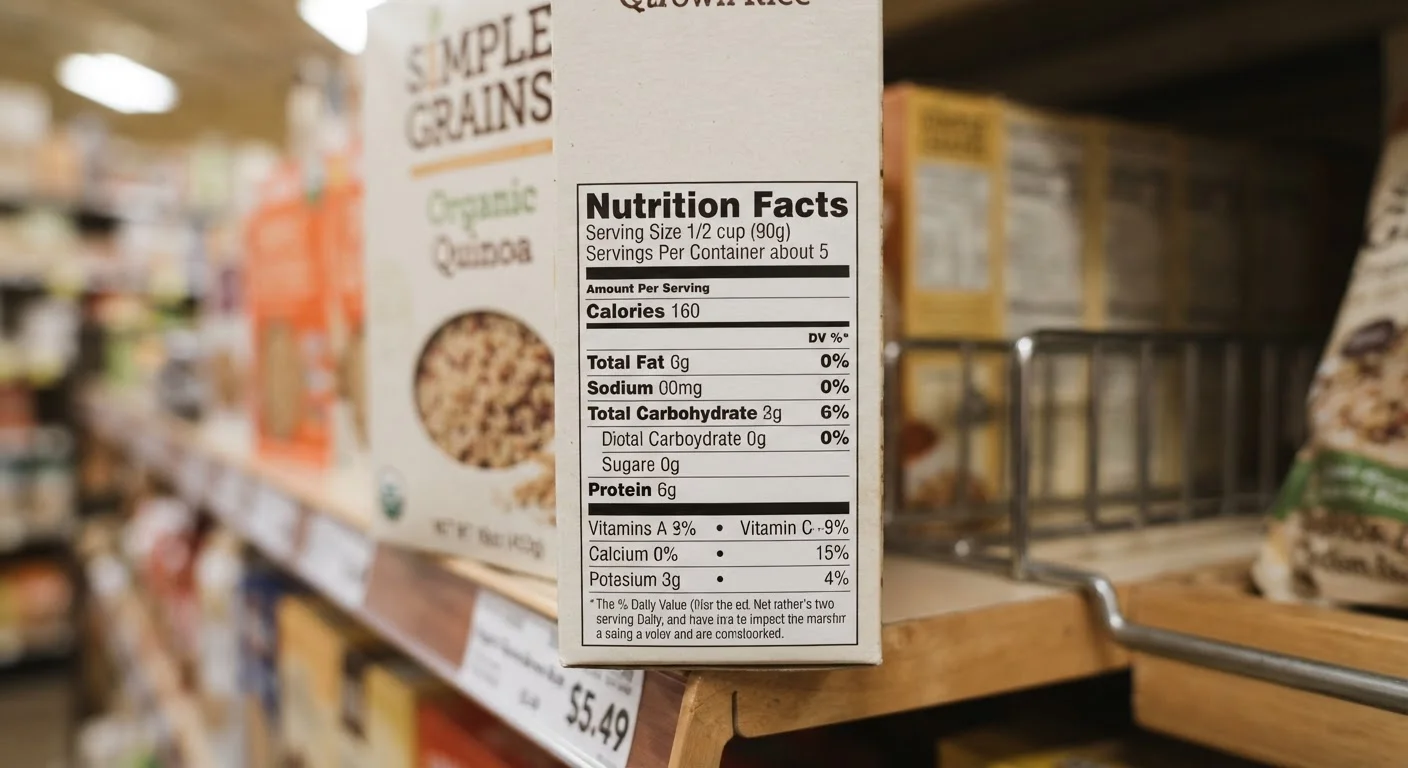
Photo credit: ExplorerGrid.com | Endless Grid Of Factual Content
In this article
Decode serving sizes, daily values, and ingredient lists on packaged foods with this practical walkthrough.
Key Takeaways
- Serving size controls all other numbers on the label — always check it first.
- % Daily Value shows how a nutrient fits into a 2,000-calorie reference diet.
- Ingredients are listed by weight from most to least abundant.
- Added sugars are now separated from total sugars on updated US labels.
- Sodium, saturated fat, and added sugar are the nutrients most Americans benefit from limiting.
Why the Nutrition Facts Label Exists
The Nutrition Facts label is a federally standardized panel required on most packaged foods sold in the United States. It was redesigned by the FDA in 2016 — with full compliance by 2020 — to reflect updated nutrition science and make key information easier to spot at a glance. If you're new to thinking critically about what you eat, our practical nutrition primer is a helpful starting point before diving into label mechanics.
The label is not a verdict on whether a food is "good" or "bad." It's a standardized snapshot of what a food contains per serving. Learning to read it accurately helps you understand context rather than react to marketing claims on the front of the package.
How to Read Each Section of the Label
Work through the label from top to bottom — each section builds on the one before it.
Check the Serving Size First
Every number on the label — calories, fat, sodium, vitamins — refers to one serving as defined on the label, not the entire package. The serving size is based on typical consumption amounts established by the FDA, expressed in common household measures (e.g., "2/3 cup") followed by grams. If you eat double the serving size, every value doubles. This is the single most important thing to anchor before reading anything else.
Note the Calorie Count
Calories appear in large, bold type directly below the serving size. This represents total energy per serving from all macronutrients. The label does not break calories down by source anymore (the older format showed "Calories from Fat"), but the macronutrient grams below let you calculate this if needed.
Review Nutrients to Limit
Saturated fat, sodium, and added sugars are grouped toward the top of the nutrient section because most Americans consume these in excess relative to public health guidelines. The label lists total fat first, then breaks out saturated and trans fat beneath it. Dietary cholesterol follows. Scan these lines together rather than in isolation.
Look at Nutrients to Encourage
Dietary fiber, vitamin D, calcium, iron, and potassium are listed lower on the panel. These are nutrients many Americans fall short on. The label highlights them to help consumers identify foods that contribute meaningfully to these needs. High % Daily Values for these nutrients are generally favorable.
Interpret % Daily Value in Context
The right-hand column shows % Daily Value (% DV) for most nutrients. These percentages are based on a 2,000-calorie reference diet — a standardized benchmark, not a recommendation for any individual. Use % DV to compare products and to gauge whether a food contributes a little or a lot of a given nutrient per serving. Someone with different calorie needs will need to adjust their interpretation accordingly.
For a deeper look at how vitamins and minerals appear on labels, see our guide to key vitamins and minerals. And if the added sugars line has you curious, added sugar vs. natural sugar explains the distinction clearly.
This Is General Information, Not Personal Advice
This article explains how to read Nutrition Facts labels for general educational purposes. It is not a substitute for personalized dietary guidance. If you have a health condition, food allergy, or specific nutritional needs, consult a registered dietitian or your healthcare provider before making significant dietary changes.
The Ingredient List: What It Adds That the Panel Doesn't
The Nutrition Facts panel tells you how much; the ingredient list tells you what. Ingredients are listed in descending order by weight — the first ingredient is present in the largest amount. This matters when evaluating foods where a headline ingredient (say, whole grain oats) appears third or fourth after refined flour and sugar.
Watch for added sugars listed under multiple names — corn syrup, dextrose, maltose, fruit juice concentrate — which can be spread across the list to make sugar appear less prominent overall. The panel's dedicated "Added Sugars" line helps counter this, but cross-referencing with the ingredient list gives you the full picture. Our nutrition terms glossary defines many of the ingredients and phrases you'll encounter.
Allergens required by US law — including milk, eggs, fish, shellfish, tree nuts, peanuts, wheat, and soybeans — must be clearly declared, either within the ingredient list or in a separate "Contains" statement below it.
Common Misconceptions That Lead to Label Confusion
Several label elements reliably trip readers up:
- "Per serving" vs. "per container": A bag of chips listing 140 calories per serving means nothing without noting there are 3.5 servings in the bag. The updated label now also shows calories per entire package for single-serving-style items.
- % Daily Value interpretation: The 5%/20% rule of thumb — 5% or less is low, 20% or more is high for a given nutrient — applies to one serving within a 2,000-calorie day. It is a reference point, not a personal prescription.
- "0 grams trans fat": Under FDA rules, a food can be labeled 0g trans fat if it contains less than 0.5g per serving. If partially hydrogenated oils appear in the ingredient list, trace amounts may still be present.
- "Light" or "reduced" claims: These front-of-package claims are regulated, but they mean the food is lighter or lower relative to a reference food — not necessarily low in absolute terms. Always verify on the panel itself.

Author
Health & Wellness Editorial Team
Health & Wellness Editorial Team is the collective byline for our editorial team and contributor network. Articles published under this byline or an editorial pen name are researched, written, and reviewed according to our editorial standards for clarity, consistency, and independence before publication.
View all articles →