
Hardwood vs. Engineered Wood Flooring: A Practical Breakdown
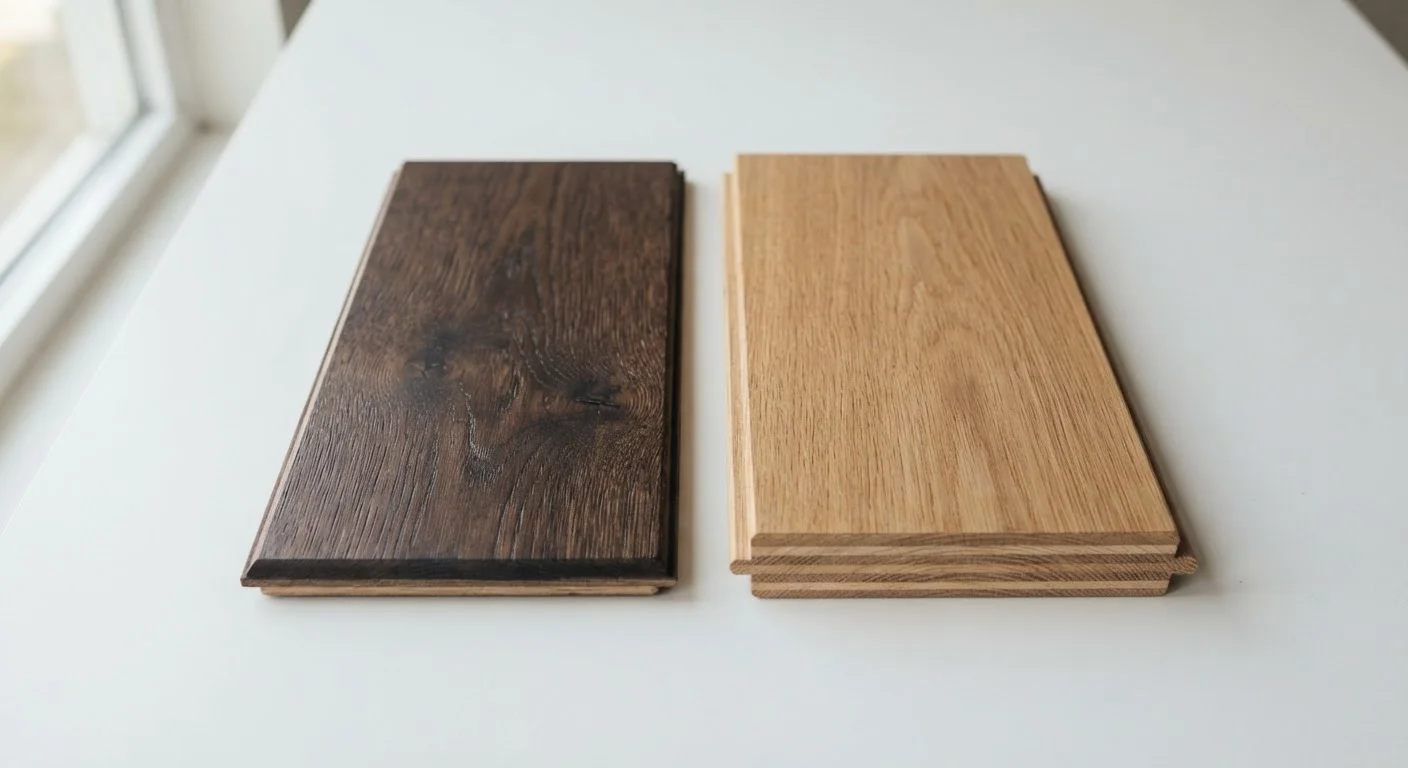
Photo credit: ExplorerGrid.com | Endless Grid Of Factual Content
In this article
Both look similar on the surface, but behave very differently with moisture, subfloors, and refinishing. Here's how they compare.
Key Takeaways
- Solid hardwood can be sanded and refinished many more times than engineered wood, extending its lifespan significantly.
- Engineered wood resists humidity and temperature swings better, making it suitable for below-grade and high-moisture spaces.
- Both options offer a real wood surface layer, so appearance is comparable at face value.
- Installation method, subfloor type, and room location are the biggest factors in choosing between the two.
- Cost differences vary widely by species and quality tier — neither option is universally cheaper.
- Local climate and home layout should guide your decision as much as budget does.
What's Actually Inside Each Plank
Understanding how each flooring type is constructed explains nearly every performance difference you'll encounter. Solid hardwood is milled from a single piece of timber — typically ¾ inch thick — from species such as oak, maple, or hickory. Because the plank is uniform wood throughout, it naturally expands and contracts with changes in humidity and temperature.
Engineered wood, by contrast, uses a thin real-wood veneer (the wear layer) bonded over multiple layers of cross-directional plywood or high-density fiberboard (HDF). This cross-ply construction counteracts the wood's natural tendency to move, giving engineered planks far greater dimensional stability in variable conditions. The wear layer thickness typically ranges from 2mm to 6mm — a detail worth checking, since thicker veneers allow more refinishing passes.
| Criterion | Solid Hardwood | Engineered Wood |
|---|---|---|
| Core construction | Single solid timber plank | Wood veneer over cross-ply core |
| Typical thickness | ¾ inch standard | ⅜ to ¾ inch varies |
| Moisture resistance | Low — expands and contracts | Higher — dimensionally stable |
| Suitable installation levels | Above grade only | Above, on, and below grade |
| Subfloor compatibility | Wood subfloor required | Wood or concrete subfloor |
| Installation methods | Nail or staple down | Nail, staple, glue, or float |
| Refinishing potential | 5–8 times over lifespan | 1–3 times (veneer-dependent) |
| Expected lifespan | 80–100+ years with care | 25–50 years typically |
| DIY-friendly | Generally requires a professional | Click-lock options DIY-friendly |
Moisture, Subfloors, and Where Each Floor Can Go
Moisture is the single biggest installation constraint for wood flooring. Solid hardwood should only be installed above grade — meaning on the main floor or upper levels — and it requires a wood subfloor (plywood or OSB) that can accept nails or staples. It is not compatible with concrete slabs or consistently humid environments like basements, as prolonged moisture exposure causes cupping, warping, and gapping.
Engineered wood is significantly more flexible. Its stable core makes it appropriate for above-grade, on-grade (slab-level), and in many cases below-grade (basement) installations. Depending on the product, it can be nailed, stapled, glued, or floated — the last method requiring no fasteners at all, which is practical on concrete subfloors. Always verify the specific moisture tolerance rating of any engineered product before installing in a high-humidity space; not all engineered floors are created equal.
In regions with significant seasonal humidity swings — much of the Southeast and Midwest — engineered wood often performs more predictably even in above-grade applications, reducing the visible gaps and crowning that can affect solid hardwood in those climates.
Refinishing, Longevity, and Long-Term Maintenance
One of solid hardwood's most compelling arguments is its refinishing potential. A ¾-inch solid plank can typically be sanded and refinished five to eight times over its lifespan, allowing homeowners to address deep scratches, staining, or simply change the floor's color or sheen as tastes evolve. With proper care, solid hardwood floors can last 80 to 100 years.
Engineered wood's refinishing capacity depends entirely on wear-layer thickness. A 2mm veneer may tolerate one light sanding; a 6mm veneer could handle two or three refinishes. Once the veneer is depleted, the floor must be replaced rather than restored. However, modern factory finishes on engineered floors are often more durable than site-applied finishes, meaning the floors may simply need less maintenance over time.
Day-to-day care is similar for both: sweep regularly, clean with a damp (not wet) mop, use felt pads under furniture, and manage indoor humidity between 35–55% to minimize seasonal movement — a practice that benefits both floor types.
Managing Indoor Humidity Matters for Both
Wood flooring of any kind reacts to its environment. Maintaining indoor relative humidity between 35% and 55% year-round reduces the seasonal expansion, contraction, and gapping that shortens floor life. A whole-home humidifier or dehumidifier — depending on your region — can protect your flooring investment regardless of which type you choose. Check with your flooring manufacturer for their specific humidity guidelines, as tolerances vary by product.
Cost, Installation, and Making Your Decision
Material costs for both flooring types vary widely based on species, grade, and wear-layer quality, so it's difficult to declare one categorically less expensive. Entry-level engineered products can cost less than premium hardwood species, but high-end engineered floors with thick veneers can rival solid hardwood pricing. Where engineered wood often saves money is installation — floating click-lock systems can reduce professional labor costs, and some confident DIYers tackle them without a contractor.
Solid hardwood installation almost always requires professional nail-down or staple-down work, and site-finishing (if chosen over pre-finished planks) adds both cost and cure time during which the space is unusable.
When making your choice, work through these practical questions: Is the room above, on, or below grade? What is the subfloor material? Does your region have high seasonal humidity? How long do you plan to stay in the home? If you're in a stable, dry environment above grade and value longevity and refinishing flexibility, solid hardwood is a strong fit. If moisture, subfloor type, or installation simplicity are concerns, engineered wood offers a smart, durable alternative without sacrificing the authentic wood surface.
This article provides general educational information for homeowners. Installation requirements, building codes, and product specifications vary by region and manufacturer — always consult product documentation and a qualified flooring professional before beginning any project.

Author
Home & Garden Editorial Team
Home & Garden Editorial Team is the collective byline for our editorial team and contributor network. Articles published under this byline or an editorial pen name are researched, written, and reviewed according to our editorial standards for clarity, consistency, and independence before publication.
View all articles →