
Degree Programs vs. Bootcamps for Technical Skills: Weighing the Real Trade-Offs
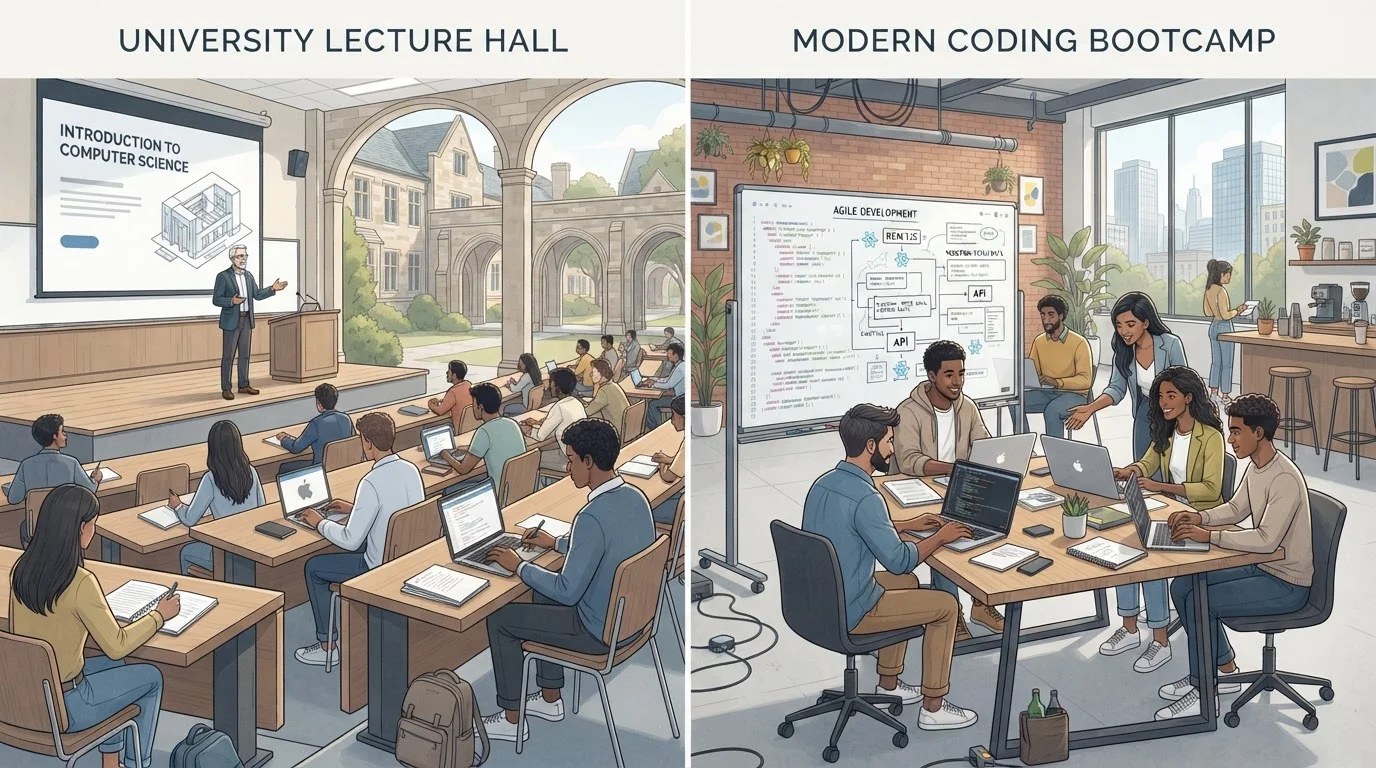
Photo credit: ExplorerGrid.com | Endless Grid Of Factual Content
In this article
Bootcamps promise speed; degrees promise depth. A side-by-side look at cost, credibility, curriculum, and career outcomes to help you think through the choice.
Key Takeaways
- Degree programs typically take two to four years and cost significantly more than bootcamps, but carry broader institutional recognition.
- Bootcamps compress technical training into weeks or months, trading depth for speed and job-readiness.
- Employer preferences vary by industry, role level, and company culture — neither path guarantees employment.
- Financial aid, income-share agreements, and employer tuition assistance can affect the real cost of either option.
- Your existing background, target role, and learning style should drive the choice more than marketing claims.
The Core Difference: Depth Versus Speed
Degree programs — typically bachelor's or associate's degrees in fields like computer science, data science, or information technology — are designed to build foundational knowledge over two to four years. They cover theory, mathematics, systems thinking, and applied skills, and they exist within an accredited academic structure that many employers recognize immediately on a resume.
Bootcamps, by contrast, are intensive short-term programs, usually running eight to twenty-four weeks, that focus narrowly on practical, job-relevant skills. A web development bootcamp, for example, might cover HTML, CSS, JavaScript, and a popular framework — enough to build a portfolio and interview for entry-level roles — without covering the underlying computer science theory.
This is the central trade-off: degrees build a wider foundation that may open more doors over a career; bootcamps build a narrower but immediately deployable skill set. Neither approach is inherently better — the right choice depends on where you're starting, where you want to go, and how much time and money you can commit.
Cost and Time: The Numbers Behind the Decision
Cost is often the deciding factor. Four-year computer science degrees at public universities commonly run tens of thousands of dollars in tuition alone, while private institutions can cost considerably more. Community college associate's degrees offer a lower-cost on-ramp, sometimes pairing with transfer pathways to four-year programs.
Bootcamps advertise tuition ranging roughly from $10,000 to $20,000 for in-person programs, with online options sometimes lower. Some programs offer income-share agreements (ISAs), where you pay after landing a job — though these arrangements carry their own financial risks and terms you should read carefully before signing. Always compare the total cost, not just the sticker price.
| Degree Program | Bootcamp | |
|---|---|---|
| Typical Duration | 2–4 years | 8–24 weeks |
| Average Cost (tuition) | $20,000–$100,000+ | $10,000–$20,000 |
| Federal Financial Aid Eligible | Yes (accredited programs) | Rarely |
| Curriculum Depth | Broad theoretical and applied | Narrow, job-focused practical |
| Employer Recognition | Widely recognized across sectors | Variable; strong in tech startups |
| Ideal For | Long-term career foundation | Fast career entry or pivot |
| Schedule Flexibility | Part-time options exist | Intensive; some part-time formats |
Time is equally significant. A full-time bootcamp can be completed in three to six months; a degree requires years. For a working adult who needs to stay employed during training, part-time bootcamps or online degree programs may change the calculus. Before enrolling in anything, working through your priorities carefully is worthwhile — see our guide on mapping your upskilling path for a structured way to do that.
Credibility and Employer Perception
Employer attitudes toward bootcamps have shifted meaningfully over the past decade, particularly in software development and UX design. Many tech companies — especially startups and mid-size firms — now evaluate candidates based on portfolio work and demonstrated skills rather than credentials alone. That said, degree requirements persist in sectors like enterprise software, government contracting, defense, and finance, where formal accreditation matters institutionally.
Accreditation is a key distinction worth understanding. Degree-granting institutions are accredited by regional or national bodies recognized by the U.S. Department of Education. Most bootcamps are not degree-granting and are not subject to the same accreditation requirements — though some have pursued state licensing or partnerships with accredited institutions. This affects not just employer perception but also eligibility for federal financial aid.
It's also worth distinguishing program completion certificates from professional certifications. A bootcamp certificate proves you completed a course; a professional certification (such as those from CompTIA or AWS) signals a validated, standardized competency. These are different signals to employers. Our article on the difference between certificates and certifications breaks this down clearly.
Curriculum Depth and What You'll Actually Learn
Degree programs cover algorithms, data structures, operating systems, software engineering principles, and often statistics or linear algebra — material that underpins more advanced technical work. For roles like machine learning engineer, systems architect, or security researcher, this theoretical grounding is frequently necessary.
Bootcamps prioritize current tools and frameworks: languages, libraries, development workflows, and portfolio-building projects. This is genuinely useful for front-end and back-end web development, data analytics, UX design, and cybersecurity fundamentals. However, bootcamp graduates often report needing to self-study foundational computer science concepts after graduation to advance beyond entry-level roles.
For adults weighing how much structure they need, it helps to reflect on your own learning style. Structured courses versus self-directed learning explores how accountability and flexibility affect outcomes differently depending on the learner.
Career Outcomes: What the Evidence Suggests
Both paths can lead to employment — but outcomes vary widely by program quality, local job market, individual effort, and how skills are presented. Bootcamps frequently publish job placement rates and salary outcomes, but these figures are self-reported and not independently verified in most cases. Look for programs that disclose their methodology transparently and be cautious of claims that cannot be substantiated.
Degree holders in computer science and related fields generally show strong long-term earnings trajectories and broader job mobility, according to federal labor statistics. Bootcamp graduates tend to enter at lower starting salaries on average, though this varies considerably. For career changers specifically, online certifications and short-form credentials also play a role — our article on what research shows about online certifications for career changers provides a grounded look at realistic outcomes.
Whichever path you choose, building a demonstrable portfolio, networking actively, and continuing to learn independently after your program ends will influence outcomes more than the credential alone.
This article is for general informational and educational purposes only. It does not constitute financial, legal, or career advice. Readers should independently verify program details, costs, and outcomes before enrolling in any educational program.

Author
Education & Learning Editorial Team
Education & Learning Editorial Team is the collective byline for our editorial team and contributor network. Articles published under this byline or an editorial pen name are researched, written, and reviewed according to our editorial standards for clarity, consistency, and independence before publication.
View all articles →