
Insulation Types Compared: Fiberglass, Spray Foam, Rigid Board, and Beyond
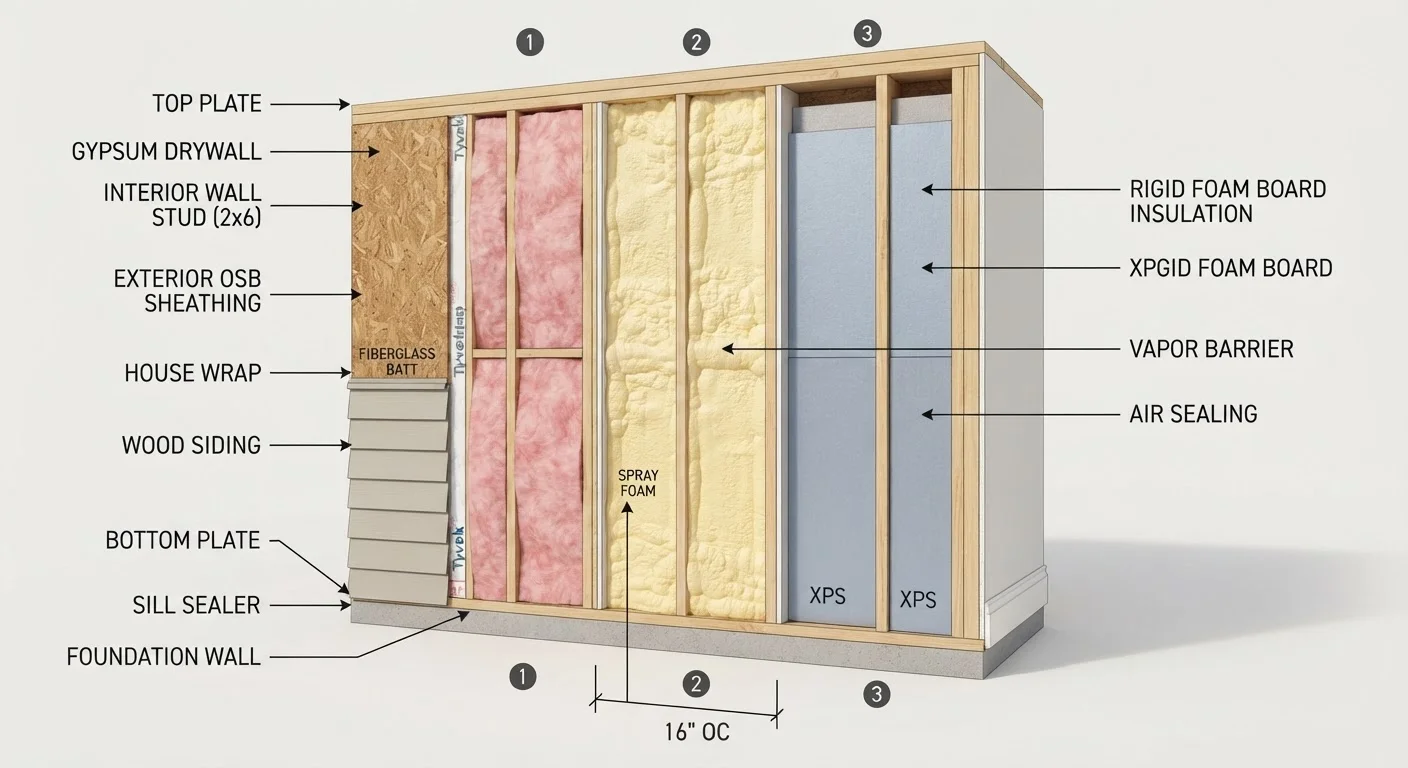
Photo credit: ExplorerGrid.com | Endless Grid Of Factual Content
In this article
Each insulation material performs differently. See how they stack up on R-value, installation complexity, moisture resistance, and cost.
Key Takeaways
- R-value measures thermal resistance per inch — higher means better insulating performance.
- Spray foam offers superior air sealing but costs significantly more than fiberglass batts.
- Rigid board insulation excels in spaces where moisture resistance is a priority.
- Cellulose is a lower-cost, eco-conscious alternative worth considering for attic applications.
- Local climate and building codes should guide which insulation type you choose.
Understanding R-Value Before You Compare
Every insulation comparison starts with R-value — a measure of thermal resistance. A higher R-value means the material slows heat transfer more effectively per inch of thickness. If you'd like a plain-language breakdown of this and other renovation terms, see our home improvement terminology guide.
R-value needs to be read in context. Climate zone, the location being insulated (attic, wall, basement), and local building codes all determine the minimum R-value required. A number that's adequate in Texas may be insufficient in Minnesota. Always check your local energy code before choosing a product.
| Fiberglass Batts | Spray Foam (Closed-Cell) | Rigid Board (XPS) | Mineral Wool | Cellulose | |
|---|---|---|---|---|---|
| R-value per inch | ~R-3.0–3.8 | ~R-6.0–7.0 | ~R-5.0 | ~R-3.0–3.3 | ~R-3.2–3.8 |
| Air sealing ability | None | Excellent | Good (with tape) | None | Minimal |
| Moisture resistance | Low | High | High | Moderate | Low–Moderate |
| Typical installation | DIY-friendly | Professional recommended | DIY-moderate | DIY-friendly | Equipment needed |
| Relative material cost | Low | High | Moderate | Moderate | Low–Moderate |
| Best application | Wall cavities, attics | Crawl spaces, rim joists | Basement walls, exterior | Walls, fire-sensitive areas | Attic floors |
Fiberglass Batts and Blown-In: The Familiar Standard
Fiberglass is the most widely installed residential insulation in the US. Batts (pre-cut panels) fit between standard stud and joist spacing and are manageable for experienced DIYers — though proper fitting is critical. Gaps, compressions, or misaligned batts can reduce effective R-value substantially.
Blown-in fiberglass fills irregular spaces more completely and is commonly used to top up attic floors. It requires rental equipment or professional installation. Neither form resists air movement on its own, so pairing fiberglass with continuous air sealing is essential for peak performance. For more on why this matters, see our article on common attic insulation misconceptions.
Spray Foam: High Performance, Higher Price
Spray polyurethane foam (SPF) comes in two varieties. Open-cell foam is softer and vapor-permeable, offering around R-3.5 per inch — suitable for interior walls in dry climates. Closed-cell foam is denser, vapor-resistant, and provides approximately R-6 to R-7 per inch, making it one of the highest-performing options available.
Closed-cell foam also acts as an air barrier, which is its major advantage over batts. Rim joists, crawl spaces, and irregularly shaped cavities benefit most from this dual function. The tradeoff is cost — spray foam typically runs several times more per square foot than fiberglass, and professional installation is strongly recommended due to chemical handling and proper ratio requirements.
Rigid Board and Mineral Wool: Specialty Applications
Rigid foam boards — including expanded polystyrene (EPS), extruded polystyrene (XPS), and polyisocyanurate (polyiso) — are installed as continuous panels on exterior walls, basement interiors, or under slabs. XPS and polyiso resist moisture well, making them appropriate for below-grade applications. Polyiso delivers the highest R-value per inch of the three (around R-6.5), though it can underperform in very cold temperatures.
Mineral wool (also called rock wool or slag wool) is a fire-resistant, moisture-tolerant option that also provides sound dampening. It performs similarly to fiberglass in thermal resistance but holds its shape better in cavities and doesn't require a separate vapor retarder in many applications. It costs more than fiberglass but less than spray foam, occupying a useful middle ground.
Cellulose, made primarily from recycled paper treated with fire retardant, is a blown-in material well-suited to attics. It offers comparable R-values to fiberglass at a lower material cost in many markets and has strong environmental credentials. These improvements can make a tangible difference in comfort — see how insulation fits into broader energy efficiency upgrades for your home.
Choosing the Right Type for Your Project
Match your insulation choice to the specific application, not just the price tag. Consider these factors:
- Location: Attics favor blown-in materials; basement walls favor rigid board or closed-cell foam; wall cavities work well with batts or open-cell foam.
- Moisture exposure: Below-grade or high-humidity areas need moisture-resistant options like XPS, polyiso, or closed-cell foam.
- Air sealing needs: Fiberglass and cellulose are not air barriers — spray foam or a separate air-sealing step is necessary if controlling infiltration is a goal.
- Budget: Fiberglass and cellulose are generally the most cost-effective materials; spray foam is the most expensive.
- Permits and codes: Some insulation projects — particularly spray foam in enclosed cavities or large-scale exterior retrofits — may require permits or professional installation. Verify local requirements before beginning any project.

Author
Home & Garden Editorial Team
Home & Garden Editorial Team is the collective byline for our editorial team and contributor network. Articles published under this byline or an editorial pen name are researched, written, and reviewed according to our editorial standards for clarity, consistency, and independence before publication.
View all articles →