
Cat Training Is Real: What Cats Can Learn and How to Teach Them
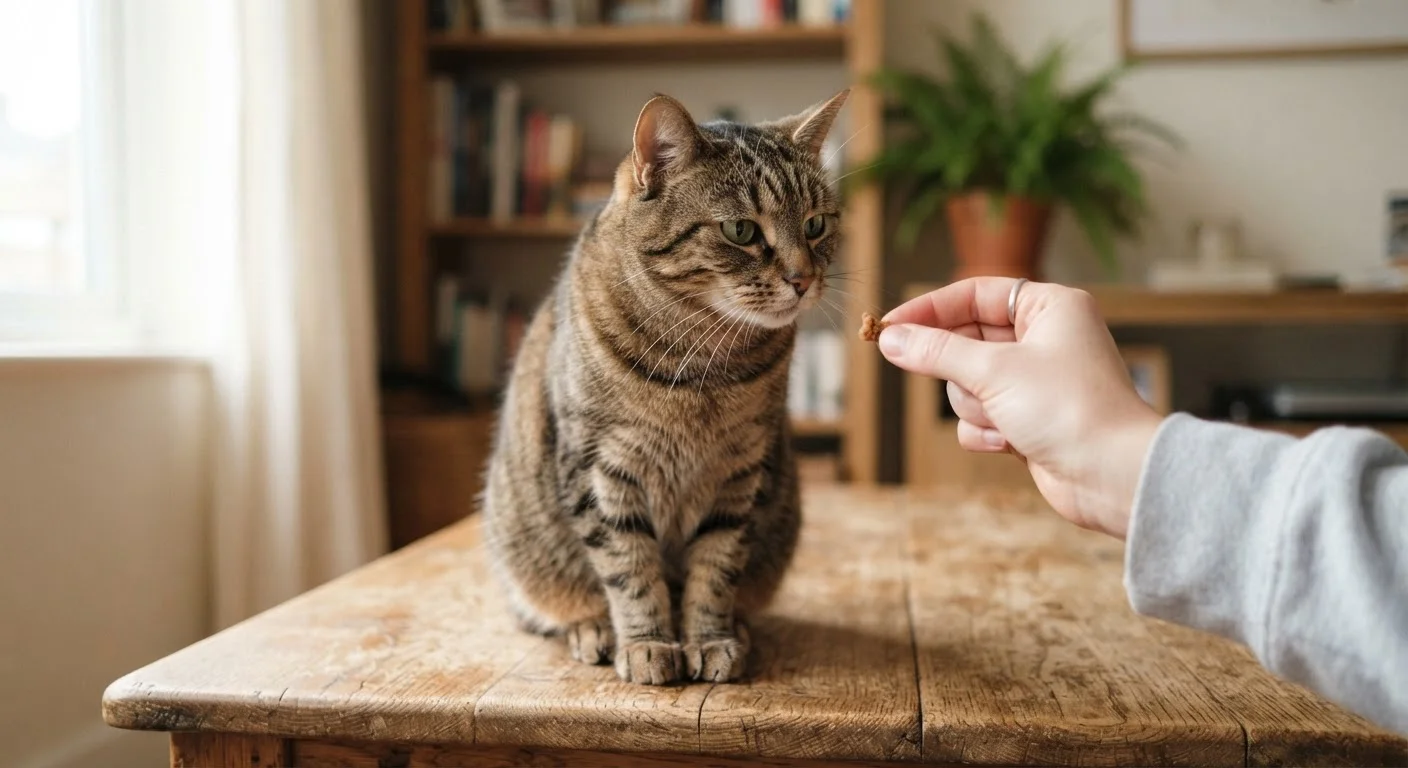
Photo credit: ExplorerGrid.com | Endless Grid Of Factual Content
In this article
Cats are trainable — they just require a different approach than dogs. This guide covers the science, realistic expectations, and where to start.
Key Takeaways
- Cats learn through operant and classical conditioning, the same mechanisms used in dog training.
- Positive reinforcement with high-value food rewards is the most effective and humane training method for cats.
- Short, frequent sessions of two to five minutes are more productive than longer ones.
- Cats can learn cues, carrier comfort, recall, and even cooperative veterinary care behaviors.
- Punishment-based methods are counterproductive and can damage the cat-owner relationship.
- Training enriches a cat's environment and supports mental health alongside physical wellbeing.
The Science Behind Cat Trainability
The persistent myth that cats are untrainable stems from a misunderstanding of feline motivation, not an absence of feline intelligence. Cats are fully capable of learning through operant conditioning — the process of associating a behavior with a consequence — as well as classical conditioning, which links a neutral stimulus to a meaningful one. These are the same foundational mechanisms applied in dog training, marine mammal research, and behavioral science broadly.
Research published in peer-reviewed behavioral journals confirms that domestic cats can acquire and retain learned behaviors across a range of complexity levels. A 2021 study in Animal Cognition demonstrated that cats can follow human pointing gestures and solve object-permanence tasks, reflecting meaningful social and cognitive flexibility. The key distinction is that cats, as a species, were domesticated as self-sufficient hunters rather than cooperative working partners — which means their motivation structure differs significantly from dogs. They work for themselves, not for approval.
This doesn't make them harder to train; it makes them require a different training philosophy. Understanding that distinction is the first step every successful cat owner takes.
What Cats Can Realistically Learn
Cat training isn't limited to circus tricks. The behavioral repertoire cats can develop is both practical and broad:
- Basic cues: Sit, stay, come (recall), and targeting a hand or object are well within reach for most cats.
- Carrier comfort: Teaching a cat to enter a carrier voluntarily is one of the highest-impact training goals for reducing veterinary stress.
- Cooperative care behaviors: Cats can learn to tolerate — and even remain calm during — nail trims, ear checks, and injection sites when conditioned gradually.
- Boundary rules: Keeping off specific surfaces or responding to a cue to leave a room can be reliably trained.
- Leash and harness tolerance: Many cats can be conditioned to walk calmly on a harness, expanding their safe outdoor enrichment.
Behavioral goals that address problem behaviors — such as redirecting scratching to appropriate posts or reducing inter-cat conflict — also fall under training, broadly defined. Unlike dogs, cats are unlikely to learn complex sequential chains quickly, but single-behavior reliability is very achievable. For a comparison of how training approaches differ across species, see our article on training adult rescue dogs.
How Positive Reinforcement Works for Cats
Positive reinforcement means adding something the cat values immediately after a desired behavior occurs, which increases the likelihood of that behavior recurring. For most cats, food is the most reliable reinforcer — specifically, small, high-palatability treats delivered within one to two seconds of the behavior.
A clicker or marker word (a consistent short sound like "yes") is used to bridge the gap between behavior and reward. The cat first learns that the click predicts food — this is classical conditioning. Once that association is solid, the click marks the precise moment a correct behavior occurs, giving the cat clear information about what earned the reward.
Use your cat's regular meal kibble as training rewards during mealtimes — this avoids caloric overload while keeping motivation high, especially for food-motivated cats.
Overfeeding high-calorie treats during frequent training sessions can contribute to weight gain, particularly in indoor cats with lower activity baselines.
Before introducing a clicker, spend two or three sessions doing nothing but click-then-treat repetitions so the cat builds a strong, automatic association between the sound and food.
A well-conditioned marker dramatically accelerates subsequent training by giving the cat unambiguous, millisecond-precise feedback about which behavior earned the reward.
When teaching a new behavior, keep your treat hand behind your back until after the marker sounds — otherwise cats learn to follow the treat, not respond to the cue.
Luring is a useful early scaffold, but transitioning away from visible food prompts ensures the cat is responding to the cue itself, making the behavior more reliable in real-world contexts.
Punishment — including spraying with water, loud noises, or physical corrections — is not recommended. The American Veterinary Society of Animal Behavior (AVSAB) explicitly advises against punishment-based training for companion animals, noting it increases fear, stress, and the risk of aggression without reliably teaching replacement behaviors. Cats trained with aversives tend to avoid their owners rather than engage with them.
Setting Up Sessions for Success
The practical architecture of a training session matters as much as the method. Keep these principles in mind:
- Duration: Two to five minutes per session. Cats habituate quickly and lose interest if sessions run long. Multiple short sessions per day outperform one long one.
- Timing: Train when your cat is alert and slightly hungry — not immediately after a meal or during a nap.
- Environment: Start in a low-distraction space. Add complexity gradually once the behavior is reliable in easy conditions.
- Treat size: Keep rewards tiny — roughly the size of a pea — so the cat stays motivated without filling up quickly.
- End on success: Finish each session on a behavior the cat can do reliably. Ending on a win keeps the cat's association with training positive.
Progress will be uneven. Some cats respond eagerly from day one; others need several sessions just to engage. Respecting individual pace is essential — a cat that walks away has communicated that the session is over, and continuing to push creates negative associations with training itself.
Common Mistakes Cat Owners Make
Even well-intentioned owners fall into predictable patterns that slow progress or erode the training relationship:
- Delayed rewards
- Handing over a treat five seconds after the behavior tells the cat nothing useful. Precision timing is essential, which is why a marker (click or word) is so valuable.
- Inconsistent cues
- Using "sit" sometimes and "sit down" other times introduces ambiguity. Choose one cue per behavior and use it consistently across all household members.
- Skipping foundational steps
- Attempting to train complex behaviors before the cat understands the basic reinforcement game leads to frustration on both sides. Teach marker conditioning first.
- Training a stressed or overstimulated cat
- A cat showing flattened ears, a lashing tail, or dilated pupils is not in a state to learn. Read body language and pause accordingly.
- Giving up after a plateau
- Plateaus are normal in any learning process. Returning to the previous step and building more slowly often resolves them.
When Training Also Improves Cat Wellbeing
Training isn't only about compliance — it's a form of environmental enrichment. Cats that engage in regular, mentally stimulating activities show fewer stress-related behaviors such as over-grooming, hiding, or inter-cat aggression. Teaching a cat to participate in its own care — remaining calm for vet exams, accepting handling — meaningfully reduces the fear and physiological stress response that many cats experience during veterinary visits, a concern the AVMA has emphasized in its companion animal welfare guidelines.
The relationship between mental stimulation, enrichment, and a cat's overall health connects to broader wellness considerations. A well-nourished, appropriately stimulated cat is a better learner. For guidance on meeting your cat's nutritional needs alongside their behavioral ones, see our article on cat nutrition across life stages.
Ultimately, training is a communication system. Cats that learn to predict outcomes, earn rewards, and interact with their owners in structured ways tend to be more confident and less reactive — qualities that benefit the entire household. The science is clear, the methods are accessible, and the starting point is simpler than most owners expect: pick one behavior, get small treats, and begin.
This article is for general informational purposes only and does not constitute veterinary or behavioral health advice. Consult a qualified veterinary behaviorist or certified animal behavior consultant for guidance tailored to your cat's individual needs.

Author
Pets & Animals Editorial Team
Pets & Animals Editorial Team is the collective byline for our editorial team and contributor network. Articles published under this byline or an editorial pen name are researched, written, and reviewed according to our editorial standards for clarity, consistency, and independence before publication.
View all articles →