
The American South as a Travel Destination: A Region-Wide Orientation
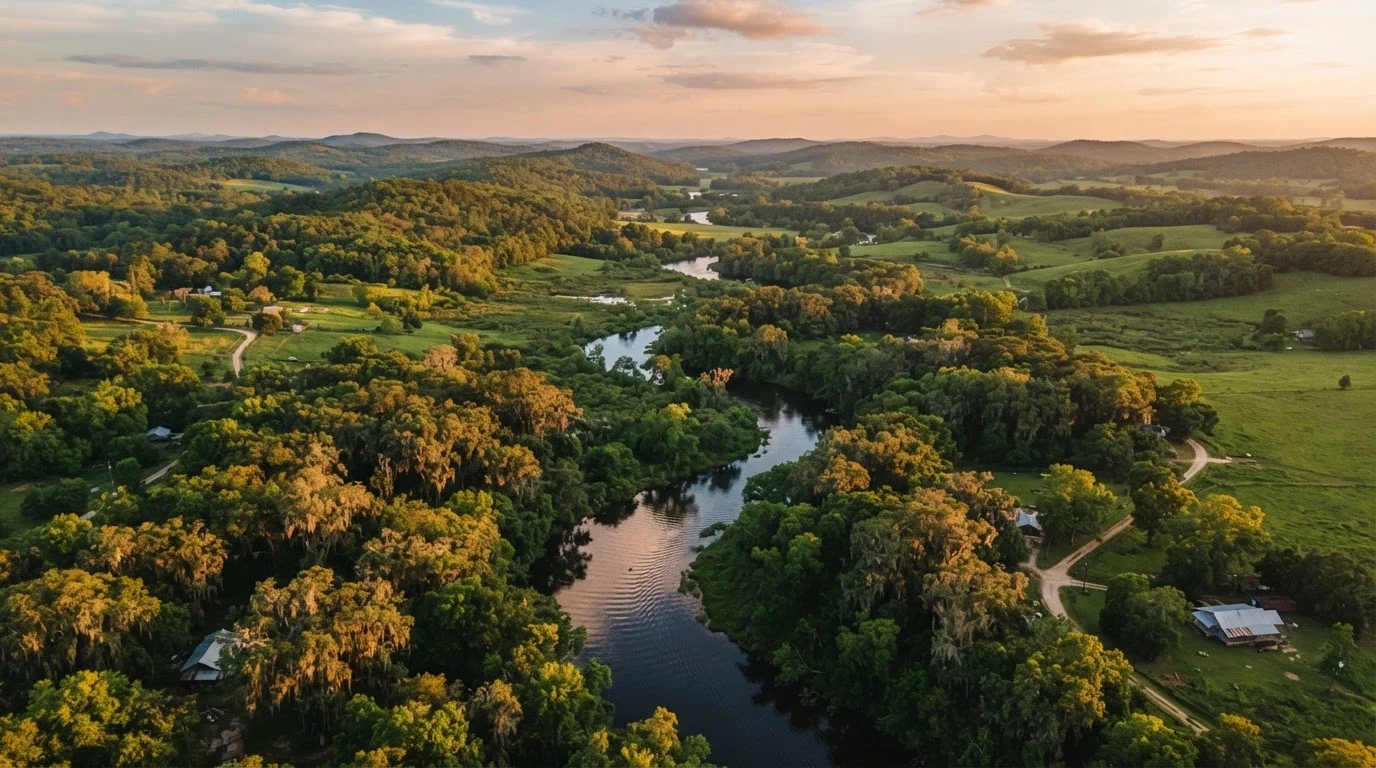
Photo credit: ExplorerGrid.com | Endless Grid Of Factual Content
In this article
From the Lowcountry to the Delta to Appalachia, the American South covers enormous cultural ground. Here's how to start thinking about it as a travel region.
Key Takeaways
- The American South is not one place — it's a collection of distinct sub-regions with different landscapes, cultures, and travel personalities.
- Appalachia, the Gulf Coast, the Mississippi Delta, the Lowcountry, and the Texas Hill Country each offer genuinely different experiences.
- Spring and fall are generally the most comfortable seasons for Southern travel, though specifics vary widely by sub-region.
- A car is essential for most Southern travel outside of a handful of walkable city cores.
- First-time visitors benefit enormously from picking one sub-region rather than trying to cover everything at once.
Why the South Defies a Single Description
Ask ten Americans what comes to mind when they think of the South, and you'll get ten different answers: jazz and magnolias, mountain hollers, Creole cooking, barrier island beaches, red clay roads, neon-lit honky-tonks. They're all right. The American South is one of the most geographically and culturally layered regions in the country, spanning roughly fifteen states and an enormous range of terrain — from sea-level Gulf marshes to peaks topping 6,000 feet in the Southern Appalachians.
That diversity is the South's greatest asset as a travel destination, and also the thing that most confuses first-time visitors. Treating the region as a single monolithic place leads to itineraries that stretch too thin or destinations that feel mismatched to what a traveler actually wanted. The better approach is to understand the South as a collection of distinct sub-regions — each with its own identity, landscape, and rhythm — and choose the one (or two) that matches your travel goals.
The South's Major Sub-Regions at a Glance
Breaking the South into its recognizable geographic and cultural zones makes trip planning far more manageable:
- Appalachia (Western NC, Eastern TN, Northern GA/AL): Rugged mountain terrain, small trail towns, acoustic music traditions, and dramatic scenery anchored by Great Smoky Mountains National Park — the most visited national park in the country.
- The Lowcountry (Coastal SC and GA): Tidal marshes, barrier islands, antebellum architecture, Gullah Geechee heritage, and unhurried coastal towns like Beaufort and Brunswick.
- The Mississippi Delta and Deep South (MS, AR, western TN): The birthplace of the Blues, Delta farmland flatness, the civil rights trail, and an essential chapter of American history hiding in plain sight.
- Gulf Coast (AL, MS coast, FL Panhandle, coastal LA): Sugar-white sand beaches, seafood-centric food culture, and a laid-back pace that ranges from family resort towns to Mardi Gras-soaked New Orleans.
- The Piedmont and Urban South (Atlanta, Charlotte, Durham, Birmingham): A cluster of fast-growing cities with vibrant food scenes, strong arts communities, and a Southern character that's evolving in real time.
- Texas Hill Country: Technically its own beast — rolling cedar hills, spring-fed rivers, German immigrant heritage towns, and wildflower season in spring.
#1
Most Visited US National Park
Great Smoky Mountains National Park consistently draws more visitors annually than any other national park in the US, according to National Park Service data.
15
States commonly defined as the American South
Geographic and cultural definitions vary, but most regional frameworks include between 11 and 16 states stretching from Virginia to Texas.
6,684 ft
Elevation of Clingmans Dome, Great Smoky Mountains
The highest point in the Smoky Mountains and on the entire Appalachian Trail, offering panoramic views across Tennessee and North Carolina.
What Kind of Traveler Does the South Suit?
The honest answer: almost any kind, as long as expectations align with the sub-region. Outdoor adventurers will find world-class hiking, paddling, and fishing in Appalachia and the Ozarks. History-focused travelers have a remarkably dense trail to follow — from Civil War battlefields to civil rights landmarks to Indigenous heritage sites. Food travelers routinely cite the South as one of the richest culinary regions in the country, with distinct traditions varying by state and even by county.
Music tourism is practically a genre unto itself here: Nashville, Memphis, New Orleans, and the Mississippi Delta each anchor a different chapter of American sound. Slow-travel enthusiasts who prefer depth over breadth tend to thrive in the South's smaller towns, where a single long weekend can feel genuinely immersive rather than rushed.
If you're drawn more to dramatic western landscapes and sweeping vistas, it may be worth comparing your options — our look at what the Southwest's national parks actually offer lays out a useful contrast.
Seasons, Climate, and When to Go
Southern climate varies dramatically across sub-regions, but some broad patterns hold:
- Spring (March–May) is widely considered the best time for most of the South — mild temperatures, wildflowers, and festivals before the heat settles in.
- Summer (June–August) brings intense humidity and heat to most of the region. The Gulf and Atlantic coasts stay busy with beach visitors; the mountains offer a relatively cooler refuge.
- Fall (September–November) is a strong second choice — Appalachian foliage peaks in mid-October and rivals New England for color, while coastal and Delta travel becomes genuinely pleasant again.
- Winter (December–February) is mild enough in coastal and Gulf areas to be enjoyable; expect occasional snow in Appalachia and cold snaps across the Deep South.
Hurricane season (June through November, peaking August–October) is a meaningful consideration for Gulf and Atlantic coastal itineraries. Always check current forecasts and travel advisories from official sources before committing to coastal trips during that window.
Practical Orientation: Getting Around the Region
A car is effectively non-negotiable for most Southern travel. Public transit infrastructure outside of a few city centers is limited, and the distances between meaningful destinations are real. Road tripping is not just practical here — it's part of the experience. Routes like the Natchez Trace Parkway, the Blue Ridge Parkway, and Highway 61 (the Blues Highway) are destinations in their own right.
When driving between Southern cities, budget at least 20% more time than the GPS predicts — small towns worth stopping in tend to appear without warning, and that's the whole point.
Some of the most memorable Southern travel moments happen in unplanned stops: a roadside BBQ joint, a state historical marker that turns into a two-hour detour, a courthouse square that demands a walk.
If your itinerary includes New Orleans, consider arriving at least a day before the main event — the city has a way of absorbing your schedule faster than expected, and jet lag or a long drive can dull your first impressions.
New Orleans is one of the densest experiential destinations in the country; arriving rested and unhurried consistently makes for a more satisfying visit.
Major airports with the strongest connections into the South include Atlanta (a hub for the entire region), Charlotte, Nashville, New Orleans, and Dallas-Fort Worth. Budget meaningful drive time between sub-regions — crossing from the Smoky Mountains to New Orleans, for example, is a full day behind the wheel.
Building Your First Southern Trip
The single most useful piece of advice for a first Southern trip: resist the urge to cover too much geography. The South rewards slow, focused exploration far more than a highlights reel that hops between cities every day. Pick one sub-region, build depth into your itinerary, and leave room to linger.
Once you've chosen a focus area, the logistics fall into place more naturally. Our guide to building a travel itinerary that actually works walks through how to structure days without over-scheduling, and if you're newer to independent travel planning, the anatomy of a well-planned trip covers the full research-to-departure process. The South is patient — it'll have more waiting for your next visit than you can possibly see in one.

Author
Travel & Trips Editorial Team
Travel & Trips Editorial Team is the collective byline for our editorial team and contributor network. Articles published under this byline or an editorial pen name are researched, written, and reviewed according to our editorial standards for clarity, consistency, and independence before publication.
View all articles →