
How Dealer Financing Works and What It Means for the Price You Pay
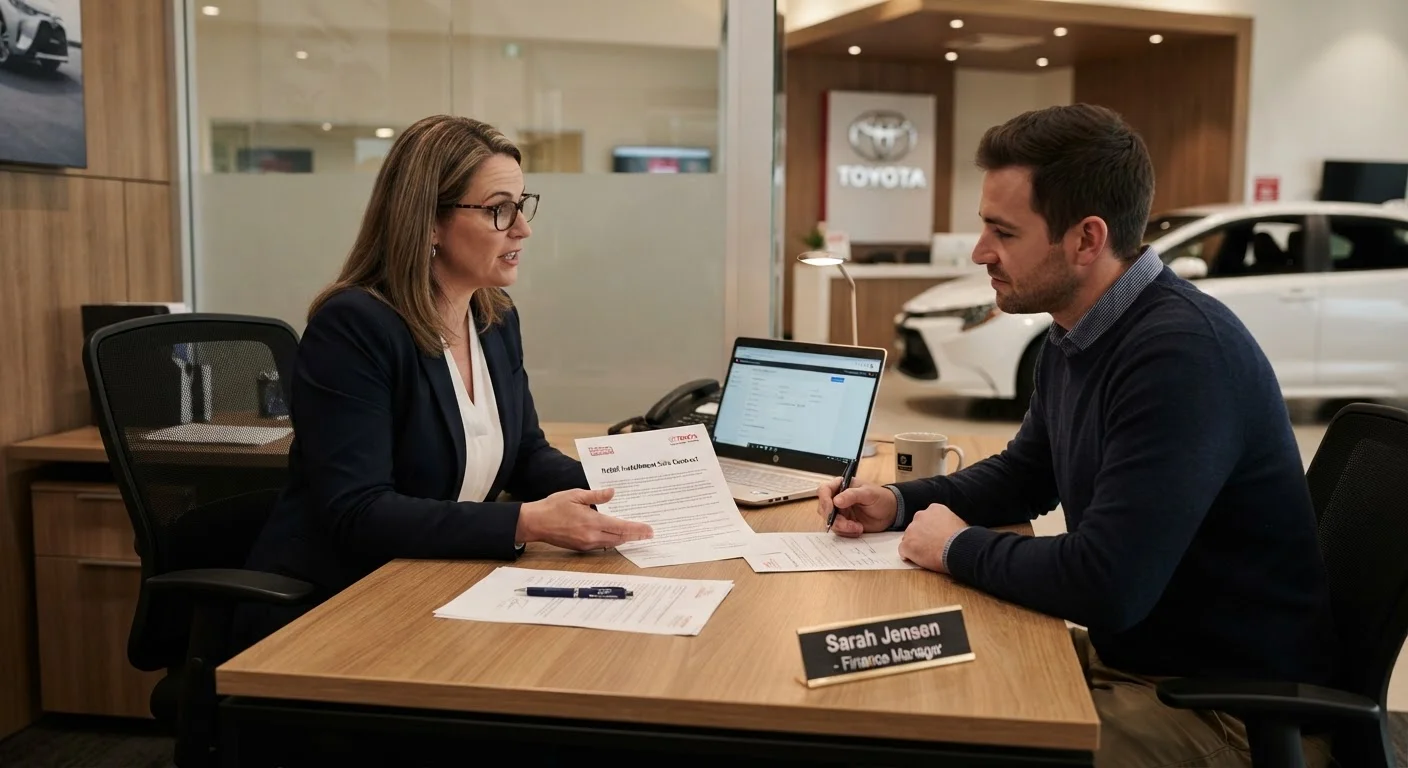
Photo credit: ExplorerGrid.com | Endless Grid Of Factual Content
In this article
Learn how dealership financing is structured, how it differs from direct lending, and what to watch for in the finance office.
Key Takeaways
- Dealerships act as intermediaries between buyers and lenders — they do not typically fund loans themselves.
- Dealers can mark up the interest rate above what the lender actually approved, increasing your total loan cost.
- Negotiating the vehicle price and the financing terms separately gives you clearer control over each.
- Getting a pre-approval from a bank or credit union before visiting a dealer strengthens your negotiating position.
- Add-on products offered in the finance office — like extended warranties — are optional and often negotiable.
- The annual percentage rate (APR) is the most accurate figure for comparing loan offers across lenders.
How the Dealer Finance Office Actually Works
When most people think about buying a car, they focus on the sticker price. But a significant portion of the financial negotiation happens in a room many buyers enter without fully understanding it: the finance and insurance (F&I) office.
After you agree on a vehicle price, the F&I manager takes over. Their role is to structure your purchase contract, arrange financing if needed, and present a menu of optional add-on products. The dealership earns revenue at each of these steps — not just from the car sale itself.
When you apply for financing through a dealer, the dealer submits your credit application to a roster of lenders: banks, credit unions, and often the automaker's captive finance company (such as a manufacturer's own lending arm). Each lender responds with a rate it's willing to offer based on your credit profile, income, and loan terms. The dealer then selects an offer to present to you — and in most cases, is permitted to mark up that rate before quoting it.
APR Is the Right Number to Compare
When evaluating any loan offer, focus on the annual percentage rate (APR) rather than the monthly payment. Monthly payments can be manipulated by extending the loan term — making a more expensive loan appear affordable. APR reflects the true annual cost of borrowing and allows accurate apples-to-apples comparison between offers.
Understanding how this process works before you sit down is one of the most effective steps you can take. For a broader look at costs that surface after a price is agreed, see our guide on hidden fees that inflate the real price of buying a car.
The Rate Markup: Where Dealer Profit Meets Your Monthly Payment
The interest rate markup — often called the dealer reserve or finance reserve — is one of the least visible costs in a vehicle purchase. Here's how it works in practice: a lender might approve you at a 5.5% annual percentage rate (APR). The dealer quotes you 7.5%. The lender receives 5.5%, and the dealer earns a portion of the 2-point spread over the life of the loan. On a $30,000 loan over 60 months, that difference can amount to roughly $1,600 or more in additional interest paid.
Federal regulators, including the Consumer Financial Protection Bureau, have scrutinized this practice, and some lenders cap the allowable markup. But markups remain common and legal within those limits.
The practical defense is straightforward: arrive with a pre-approved loan from your own bank or credit union. This gives you a concrete benchmark. If the dealer can beat your pre-approval — whether through a lower rate or a manufacturer promotional offer — great. If not, you have financing ready to use. This separation of vehicle price from financing terms is a core habit covered in our article on why buyers overpay at dealerships.
~$1,500
Estimated cost of a 2-point rate markup
On a $30,000, 60-month loan, a 2-percentage-point dealer rate markup typically adds roughly $1,500 in total interest paid over the loan term.
80%+
New car buyers who use financing
According to Experian's automotive finance data, the majority of new vehicle purchases in the US involve some form of financing rather than outright purchase.
67+ months
Average new car loan term length
Experian's State of the Automotive Finance Market reports have consistently shown average new vehicle loan terms extending beyond 67 months in recent years.
Add-On Products: Optional, But Often Presented as Expected
Beyond the loan itself, the F&I office is also the venue for a range of ancillary products. Extended service contracts (commonly called extended warranties), gap insurance, credit life and disability insurance, and appearance protection packages are all typical offerings. Each of these may have legitimate value depending on your situation, but they share a few characteristics worth understanding:
- They are optional. No lender requires most of these products as a condition of your loan, though the presentation can imply otherwise.
- Their cost is often folded into the loan. This means you pay interest on the product price for the life of the loan, increasing its effective cost.
- Their prices are negotiable. Like the vehicle itself, the sticker price of add-on products is typically not fixed.
Gap insurance — which covers the difference between what you owe on a loan and what your vehicle is worth if it's totaled — can be a genuinely useful product for buyers financing a large percentage of a vehicle's value. However, it's often available from your own auto insurer at a lower cost than what dealerships charge. Compare options before committing.
For anyone new to this process, our primer on what first-time car buyers need to understand offers a grounded walkthrough of what to expect before and during a dealership visit.
Comparing Dealer Financing to Direct Lending
Direct lending means securing a loan from a financial institution — your bank, credit union, or an online lender — before you arrive at a dealership. You walk in knowing your approved amount, your rate, and your terms. The dealer's financing then competes against a real offer rather than an unknown.
Dealer financing offers genuine convenience: one application, multiple lenders, and the ability to drive off the lot the same day. Manufacturer promotional rates — often offered on new vehicles to move inventory — can also be legitimately competitive, sometimes 0% APR for well-qualified buyers. These rates are subsidized by the automaker and are not subject to dealer markup in most cases, making them worth evaluating on their own merits.
The question isn't whether dealer financing is inherently worse than direct lending — it's whether the specific offer on the table is competitive. The only reliable way to answer that is to have an independent offer for comparison. To understand how loan term length and interest rate interact to shape your total cost, see our explainer on auto loan interest and financing terms.
Whether you buy from a dealership or a private seller also shapes which financing options are even available to you — a distinction explored in depth in our article on private seller vs. dealership buying trade-offs.
This article is for general informational purposes only and does not constitute financial or legal advice. Consult a qualified financial professional for guidance tailored to your individual circumstances.
Frequently Asked Questions

Author
Automotive Editorial Team
Automotive Editorial Team is the collective byline for our editorial team and contributor network. Articles published under this byline or an editorial pen name are researched, written, and reviewed according to our editorial standards for clarity, consistency, and independence before publication.
View all articles →