
Hidden Fees That Inflate the Real Price of Buying a Car
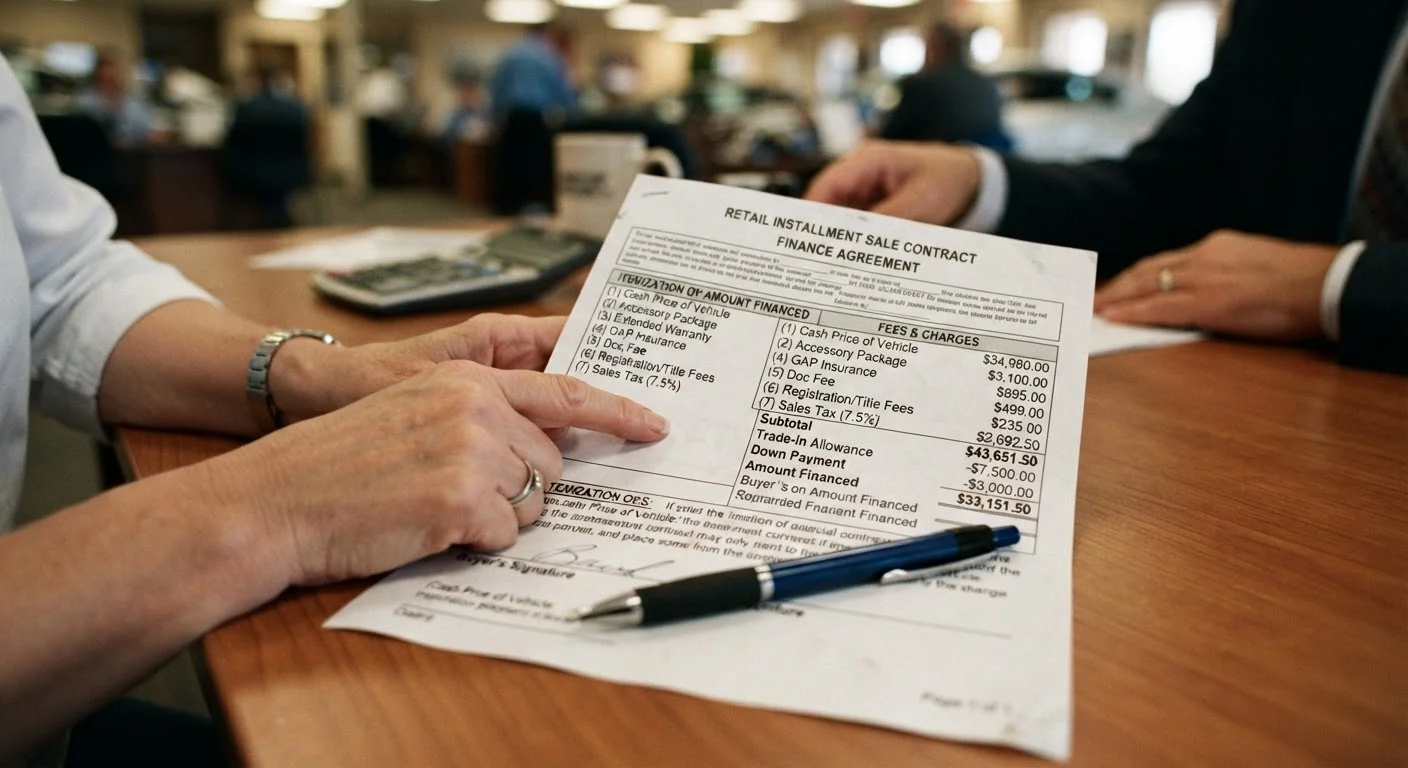
Photo credit: ExplorerGrid.com | Endless Grid Of Factual Content
In this article
Documentation fees, dealer add-ons, title and registration charges—a plain-language guide to the costs that appear after you've agreed on a price.
Key Takeaways
- Dealer fees, add-ons, and financing markups routinely add $1,000–$5,000 above a negotiated vehicle price.
- Some fees are legally required and non-negotiable; others are dealer-imposed and can be challenged or removed.
- Reviewing the itemized purchase agreement before signing is the single most effective way to catch inflated charges.
- Financing through a dealership can carry an interest rate markup that increases total loan cost significantly.
- Knowing which fees to expect puts buyers in a stronger position at the signing table.
Why the Negotiated Price Is Just the Starting Point
You've spent hours researching, test-driven your shortlist, and finally agreed on a number with the salesperson. Then you sit down in the finance office — and the price on the paperwork is noticeably higher. This gap is not accidental. Dealerships generate a meaningful portion of their revenue not from vehicle sales but from fees added after the handshake.
Understanding which charges are legitimate, which are inflated, and which are entirely optional is one of the most practical skills a car buyer can develop. For a broader view of what vehicle ownership ultimately costs beyond the purchase itself, see the true cost of car ownership. This guide focuses specifically on the fees that appear between the price you agreed on and the amount you actually sign for.
Documentation Fee
The documentation fee — often called the "doc fee" — covers the dealership's cost of preparing the title, registration paperwork, and sales contract. It sounds routine, but the range is wide: some states cap it by law (California limits doc fees to a few hundred dollars), while others impose no ceiling at all, allowing dealers to charge $500–$900 or more. The fee itself is generally legitimate, but the amount is sometimes negotiable, particularly if it sits at the high end of your state's typical range. Always confirm the prevailing norm for your state before you arrive.
Doc fees can legally vary by hundreds of dollars depending on the state and the dealer.
Dealer-Installed Add-Ons
Paint protection film, fabric sealant, nitrogen-filled tires, window tinting, and GPS tracking systems often appear as pre-installed line items costing $200–$1,500 each. These are sometimes listed on the vehicle's window sticker as "dealer-installed options," implying they are part of the car's price. In many cases, buyers can decline to pay for these add-ons or negotiate the vehicle price down by an equivalent amount. Some products have genuine utility; others offer minimal value at a steep markup. Before agreeing to any add-on, ask for the manufacturer's or installer's invoice — not just the retail price the dealer is charging.
Pre-installed dealer add-ons are frequently optional and often priced well above their actual cost.
Destination and Advertising Fees
The destination charge — what it costs to ship the vehicle from the manufacturer's plant to the dealership — is a legitimate, standardized fee set by the manufacturer and applied uniformly. It ranges from roughly $900 to $1,800 depending on the vehicle. This one is non-negotiable and should already be factored into any advertised price. However, some dealers also add a separate "advertising fee" or "regional marketing fee" representing their share of manufacturer ad campaigns. This charge is generally not negotiable, but it should be disclosed upfront and included in any out-the-door price comparison you make across dealerships.
Destination charges are fixed by the manufacturer; advertising fees vary and should appear in out-the-door pricing.
Title, Registration, and Government Taxes
Sales tax, title transfer fees, and registration costs are set by state and local governments — none of these are dealer-controlled. Depending on the state, sales tax alone can add 4%–10% to a vehicle's purchase price, and registration fees vary widely based on vehicle weight, value, or both. These charges are non-negotiable, but buyers sometimes overlook them when comparing out-of-state prices or calculating a budget. Always request the total out-the-door price inclusive of all taxes and government fees before making a final comparison between dealerships or purchase options.
State and local taxes can add thousands to a vehicle purchase and are entirely outside dealer control.
Finance Office Rate Markup
When a dealership arranges financing on your behalf, it acts as an intermediary between you and a lender. The lender quotes a "buy rate" — the minimum interest rate they'll accept — and the dealer is often permitted to mark that rate up and keep the difference as compensation. A markup of just one or two percentage points on a $35,000 loan over 60 months can add $1,000–$2,000 to the total cost of the loan. How loan terms and interest rates interact matters enormously here. Arriving with a pre-approved rate from a bank or credit union gives you a direct benchmark and removes the dealer's leverage on this point. See also common negotiation myths for related pitfalls.
A two-point interest rate markup on a typical auto loan can quietly cost the buyer over $1,500.
Extended Warranties and Service Contracts
Extended warranties — more precisely called vehicle service contracts — are frequently presented in the finance office as near-essential protection, often at prices of $1,500–$3,500. These are optional products with varying coverage terms, exclusions, and deductibles. They are also among the highest-margin items a dealer sells, and the price itself is negotiable. If you're considering one, ask for the contract document to review coverage details before signing, compare what the manufacturer's existing warranty still covers, and recognize that you are not required to decide on the spot. Common assumptions about extended warranties are worth examining before committing.
Extended warranties are optional, negotiable, and often sold at significant markup in the finance office.
How to Protect Yourself at the Signing Table
The finance office is where preparation pays off most. Request a fully itemized worksheet before signing anything and compare each line to what you expected. Ask for a plain-language explanation of any fee you don't recognize — a legitimate charge will have a clear answer. If a dealer add-on was installed without your prior consent, you can often negotiate its removal or a price reduction equal to its cost.
On the financing side, always compare the dealership's offered rate against a pre-approval from your bank or credit union before the appointment. Understanding how dealer financing is structured will help you recognize when a rate has been marked up. For a closer look at patterns that lead buyers to overpay more broadly, examining dealership overpayment habits is a useful companion read.
Ask for the Out-the-Door Price in Writing
Before you commit to any vehicle, request a written out-the-door price that includes every fee, tax, and add-on. This single document makes it straightforward to compare offers across dealerships and identify charges that weren't discussed during negotiation. Dealers are generally willing to provide this — and reluctance to do so is itself informative.

Author
Automotive Editorial Team
Automotive Editorial Team is the collective byline for our editorial team and contributor network. Articles published under this byline or an editorial pen name are researched, written, and reviewed according to our editorial standards for clarity, consistency, and independence before publication.
View all articles →