
Smoke Alarms, CO Detectors, and Fire Extinguishers: A Homeowner's Safety Baseline
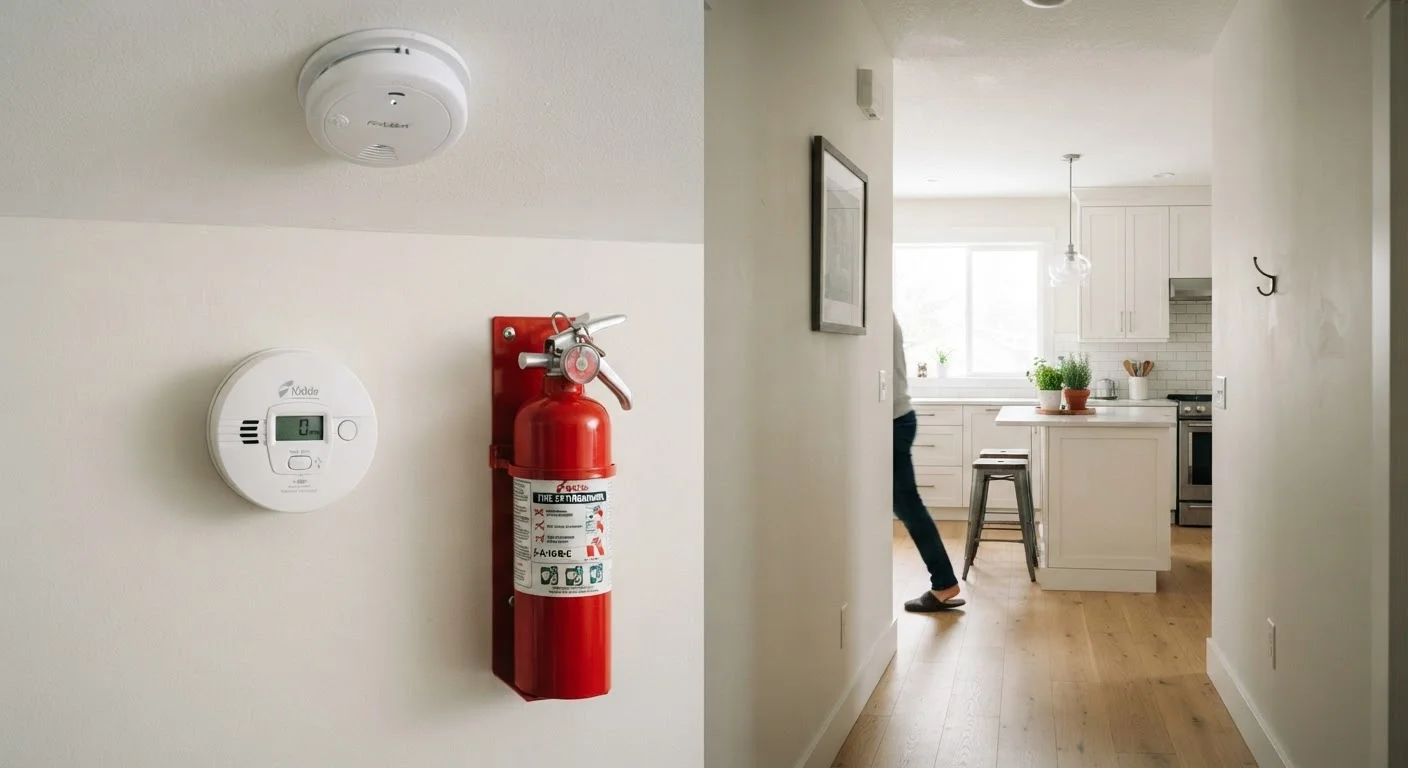
Photo credit: ExplorerGrid.com | Endless Grid Of Factual Content
In this article
Understand where these safety devices belong, how often to test them, and what current guidelines say about replacement intervals.
Where Each Device Belongs
Placement determines whether a safety device can do its job in time. Each of the three core devices has distinct location requirements based on how the hazard it detects behaves.
Smoke Alarms
The NFPA recommends installing smoke alarms on every level of the home, inside each bedroom, and outside every sleeping area. In two-story homes, that means a minimum of one alarm per floor plus individual bedroom coverage. Mount alarms on or near the ceiling — smoke rises, so ceiling placement (or high on a wall, no more than 12 inches from the ceiling) gives the earliest detection. Keep them at least 10 feet from cooking appliances to reduce nuisance trips.
Carbon Monoxide Detectors
CO is roughly the same weight as air, so it disperses evenly rather than rising or sinking. Place detectors at knee-to-eye height on walls — roughly 5 feet from the floor works for most models, though always follow the manufacturer's instructions. Install at least one detector on each level and within 10 feet of every sleeping area. Homes with attached garages, gas appliances, or fuel-burning heating systems are at higher risk and warrant extra coverage. See warning signs most homeowners miss for a broader look at how ventilation and combustion issues can surface.
Fire Extinguishers
Keep at least one extinguisher in the kitchen — the most common origin point for home fires — mounted in an accessible spot that isn't directly beside the stove (heat and smoke may block your path to it). Additional units are advisable near the garage and workshop areas. Mount at a height reachable by all adults in the household, typically with the handle no higher than 5 feet off the floor.
| Smoke alarm test frequency | Monthly (NFPA 72 guidance) |
| Smoke alarm replacement interval | Every 10 years from manufacture date (NFPA 72 guidance) |
| CO detector service life | 5–7 years (model-dependent) (Typical manufacturer specifications) |
| Fire extinguisher pressure check | Monthly visual inspection (NFPA 10 guidance) |
| Professional extinguisher service | Annually by a qualified service provider (NFPA 10 guidance) |
| Recommended extinguisher type for homes | ABC-rated dry-chemical (Generally recommended by fire safety organizations) |
Testing Schedules and Replacement Intervals
Owning these devices is only useful if they work when needed. Each device has a specific testing rhythm and a finite service life.
Smoke Alarms
Test monthly by pressing the test button and holding it until the alarm sounds — a weak or absent response means the battery or unit needs attention. Replace batteries at least once a year (many homeowners tie this to daylight saving time changes as a reliable prompt). The entire unit should be replaced every 10 years from its manufacture date, which is stamped inside the cover. Even if it still chirps on test, aging sensors lose sensitivity.
Carbon Monoxide Detectors
Test monthly in the same way. Most CO detectors have a service life of 5 to 7 years, depending on the model — the manufacture date or expiration date is typically printed on the back. Do not assume the unit is functional beyond that window; CO sensor chemistry degrades even without obvious failure signs.
Fire Extinguishers
Inspect visually each month: check that the pressure gauge needle sits in the green zone, the pull pin is intact, and the unit shows no corrosion or damage. Have it professionally serviced annually by a qualified fire equipment service provider. Most residential dry-chemical extinguishers should be hydrostatically tested every 12 years and replaced if they fail inspection, show damage, or have been discharged even partially. Check the label for the specific interval for your unit type.
Weaving these checks into a regular home upkeep routine is the most reliable approach. The annual home maintenance calendar offers a month-by-month framework that makes it easier to stay current on tasks like these. For a comprehensive look at every major home system, including life-safety equipment, see Home Maintenance from the Ground Up.
Using a Fire Extinguisher Correctly
An extinguisher is only useful if the person holding it knows how to operate it under stress. The universally taught method is the PASS technique:
- Pull the safety pin from the handle.
- Aim the nozzle at the base of the fire, not the flames themselves.
- Squeeze the handle to discharge the agent.
- Sweep from side to side across the base of the fire until it is out.
A standard residential extinguisher typically discharges in 8 to 15 seconds — far less time than most people expect. This technique applies to ABC-rated dry-chemical units, which are the recommended type for most home use. Class A covers ordinary combustibles (wood, paper), Class B covers flammable liquids, and Class C covers energized electrical equipment.
Critical safety point: Never attempt to fight a fire if it is larger than a small, contained area, if smoke is filling the room, or if your exit path is threatened. Evacuate immediately and call 911. Fire extinguishers are intended for incipient (just-starting) fires only.
Ionization smoke alarm
A type of smoke alarm that uses a small radioactive source to ionize air between two electrical plates. It responds faster to fast-flaming fires but may be slower to detect smoldering fires.
Photoelectric smoke alarm
A smoke alarm that uses a light beam and sensor to detect the scattering effect of smoke particles. It tends to respond more quickly to slow, smoldering fires.
Carbon monoxide (CO)
A colorless, odorless gas produced by incomplete combustion of fuels. It is toxic at elevated concentrations and undetectable by human senses alone, making a CO detector essential in any home with fuel-burning equipment.
ABC-rated extinguisher
A fire extinguisher rated to combat Class A (ordinary combustibles), Class B (flammable liquids), and Class C (electrical equipment) fires. This is the standard type recommended for residential use.
PASS technique
A four-step method for operating a fire extinguisher: Pull the pin, Aim at the base, Squeeze the handle, and Sweep side to side. It is the standard training method taught by fire safety organizations.
Incipient fire
A fire in its earliest, smallest stage — typically still contained to the object or area of origin. Fire extinguishers are designed for incipient fires only; larger fires require immediate evacuation and emergency services.

Author
Home & Garden Editorial Team
Home & Garden Editorial Team is the collective byline for our editorial team and contributor network. Articles published under this byline or an editorial pen name are researched, written, and reviewed according to our editorial standards for clarity, consistency, and independence before publication.
View all articles →