
The Homeowner's Introduction to Plumbing Systems
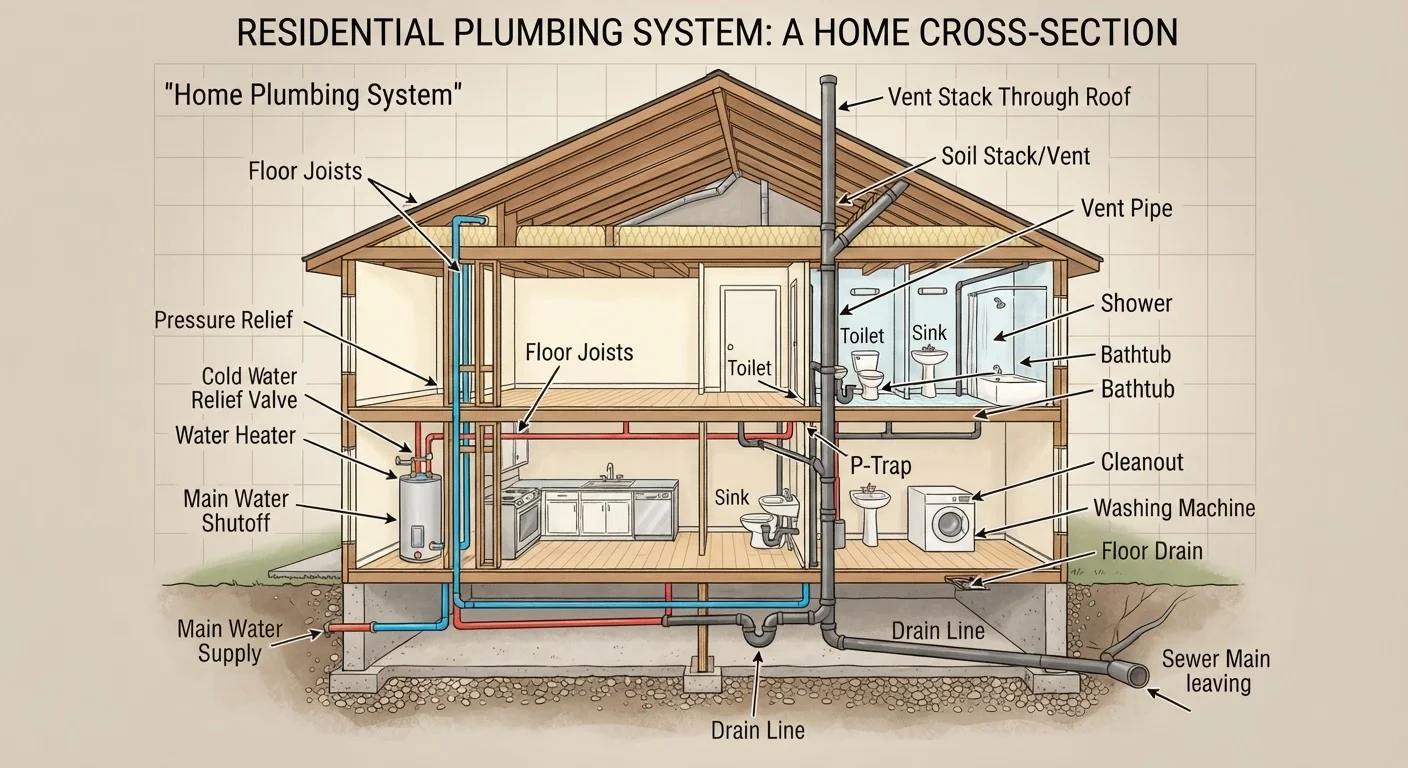
Photo credit: ExplorerGrid.com | Endless Grid Of Factual Content
In this article
Understand how your home's supply, drain, and vent lines work together — so you can spot problems early and talk to plumbers confidently.
Key Takeaways
- Every home has three plumbing subsystems: supply, drain-waste, and vent — all interdependent.
- Knowing your main shutoff valve location can prevent thousands of dollars in water damage.
- Vent pipes regulate air pressure in drain lines, and blockages there cause slow drains throughout the house.
- Seasonal checks — especially before winter — are the most cost-effective way to avoid plumbing emergencies.
- Work involving gas lines, permits, or main sewer connections should always go to a licensed plumber.
How Your Home's Plumbing Is Organized
Most homeowners interact with plumbing every day without thinking much about what's happening behind the walls. Understanding the basic structure — even at a high level — makes it far easier to spot trouble early, describe problems to a plumber accurately, and know when a situation is urgent.
A residential plumbing system has three distinct but interconnected parts:
- The supply system — pressurized pipes that bring clean water in
- The drain-waste system — gravity-fed pipes that carry used water out
- The vent system — pipes that regulate air pressure so drains flow freely
These three systems work together continuously. A problem in one almost always affects the others. For a broader look at how multiple home systems interact, see our guide on home maintenance from the ground up.
Main shutoff valve
A valve near where water enters your home that, when closed, stops all water flow to the entire house. Essential to locate before any emergency.
P-trap
The curved pipe section beneath a sink or drain that holds a water seal, blocking sewer gases from entering living spaces.
Vent stack
A vertical pipe running from the drain system up through the roof that lets air in so drains flow properly without gurgling or backing up.
Pressure-reducing valve (PRV)
A device installed on the main supply line that limits incoming water pressure to a safe level, protecting pipes and appliances from damage.
Stop valve
A small shutoff valve at an individual fixture — such as under a sink or behind a toilet — that lets you cut water to just that fixture.
Drain-waste-vent (DWV) system
The collective name for all pipes that remove wastewater and sewage from a home while venting gases safely out through the roof.
The Supply System: Water Coming In
Municipal water enters your home under pressure — typically between 40 and 80 psi (pounds per square inch) — through a main service line that connects to your water meter. From there, it branches into two paths: a cold-water line that feeds fixtures directly, and a line routed through the water heater to supply hot water.
The main shutoff valve sits near where the service line enters the house. In an emergency — a burst pipe, a leaking appliance connection — turning this valve off stops all water flow. Locate it now, before you ever need it, and make sure every adult in your household knows where it is.
Individual fixtures and appliances also have their own shutoff valves (called stop valves or angle valves), usually visible under sinks or behind toilets. These let you isolate one area without cutting water to the whole house.
If your water pressure feels unusually high or low, that's worth noting. Sustained high pressure above 80 psi can stress pipe joints and appliance connections over time. A pressure-reducing valve (PRV) — installed near the main shutoff — manages this in many homes.
The Drain-Waste-Vent System: Water Going Out
Unlike the supply system, drain lines rely on gravity rather than pressure. Wastewater flows downward through progressively larger pipes toward the main sewer line or septic tank. This means drain pipes must be installed at a specific slope — typically about ¼ inch of drop per foot of horizontal run — to prevent standing water and buildup.
Every drain fixture connects to the drain-waste system through a P-trap: the curved pipe section you can see beneath any sink. The P-trap holds a small water seal that blocks sewer gases — including hydrogen sulfide and methane — from entering your living space. If a seldom-used drain smells, the trap may have dried out; running water briefly usually restores the seal.
The vent stack is the vertical pipe that runs up through the roof. It serves a critical function: allowing air into the drain system so water flows smoothly rather than gurgling and siphoning. Blocked vents — from debris, bird nests, or ice in extreme cold — cause slow drains throughout the house, not just at one fixture. If you notice multiple drains sluggish at once, the vent system is a likely culprit. Our article on reading your home like a contractor covers how to identify these and other subtle warning signs.
Seasonal and Preventive Maintenance Basics
Plumbing problems rarely announce themselves in advance, but seasonal habits dramatically reduce the chances of an expensive emergency.
Before Winter
- Disconnect and drain outdoor hoses; shut off exterior hose bibs from inside if your home has interior shutoffs for them.
- Insulate pipes in unheated spaces — garages, crawl spaces, and against exterior walls — with foam pipe insulation before temperatures drop below freezing.
- Know the location of your main shutoff so you can act quickly if a pipe freezes or bursts.
Spring and Summer
- Inspect exposed pipes under sinks and in the basement for corrosion, moisture, or discoloration — early signs of slow leaks.
- Check your water heater's pressure relief valve annually; it should release a small amount of water when tested. Consult a plumber or the manufacturer's guidance if you're unsure how to test it safely.
- Watch your water bill for unexplained increases, which can signal a hidden leak.
Take a 15-Minute Plumbing Walkthrough
Once a season, walk through your home and visually inspect all exposed pipes under sinks, around the water heater, and in utility areas. Look for drips, staining, mineral deposits, or soft drywall nearby — these are early warnings that cost little to fix now and a lot to fix later. Photograph anything that looks unusual so you have a reference point over time.
Plumbing terminology can feel overwhelming at first. Our home improvement terminology guide explains common terms — like rough-in plumbing and shutoff valve types — in plain language.
When to Call a Licensed Plumber
Some plumbing tasks are straightforward for a capable DIYer: replacing a toilet flapper, swapping out a faucet, or unclogging a single fixture drain. Many others carry real risk — to your safety, your home's structure, or legal compliance — and belong with a licensed professional.
Call a licensed plumber for:
- Any work on the main sewer line or septic connection
- Installing or relocating pipes that require opening walls or floors
- Water heater installation or gas line work of any kind
- Persistent low pressure or water hammer (banging pipes) that you can't trace
- Any repair that likely requires a permit — verify with your local building department
Permits exist for good reason: they trigger inspections that protect you and future buyers of your home. Unpermitted plumbing work can complicate home sales and void insurance claims. For a practical framework on deciding between DIY and professional help across all home repairs, see our guide on DIY or licensed pro decisions.
Understanding your plumbing system doesn't require technical expertise — it requires knowing what's there, where it goes, and what normal looks like. That knowledge alone puts you in a far stronger position when something goes wrong.
Frequently Asked Questions

Author
Home & Garden Editorial Team
Home & Garden Editorial Team is the collective byline for our editorial team and contributor network. Articles published under this byline or an editorial pen name are researched, written, and reviewed according to our editorial standards for clarity, consistency, and independence before publication.
View all articles →