
The Debt Avalanche and Debt Snowball: Choosing a Payoff Strategy That Fits
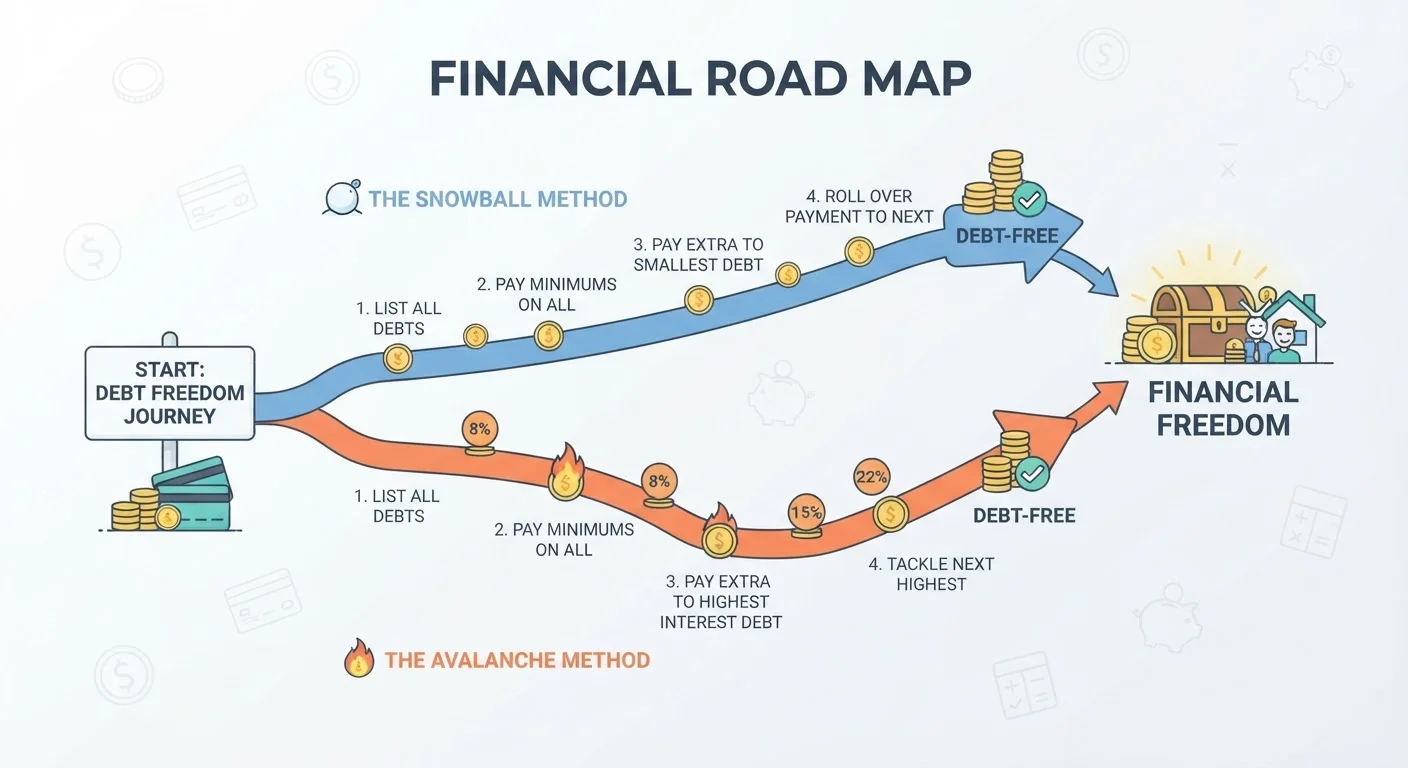
Photo credit: ExplorerGrid.com | Endless Grid Of Factual Content
In this article
Two popular debt payoff methods compared side by side — how each works, the math behind them, and which situations favor which approach.
Key Takeaways
- The debt avalanche targets the highest-interest balance first, minimizing total interest paid over time.
- The debt snowball targets the smallest balance first, building momentum through quick early wins.
- Neither method requires extra income — both work by redirecting freed-up minimum payments to the next debt.
- The best strategy is whichever one you'll consistently follow through on.
- A hybrid approach is valid: start with a small win, then shift to interest-rate order.
How Each Strategy Works
Both methods share a core mechanic: you pay the required minimum on every debt each month, then direct any extra funds toward one designated target account. When that account reaches a zero balance, you roll its former payment into the next target. The strategies differ only in how you rank those targets.
Debt Avalanche ranks debts by interest rate, from highest to lowest. You attack the most expensive debt first, regardless of its balance size. Because high-rate debts generate the most interest daily, eliminating them first reduces the total amount you'll pay over the life of your repayment plan.
Debt Snowball ranks debts by balance, from smallest to largest. You eliminate the smallest account first, regardless of its rate. Each paid-off account removes a minimum payment obligation, which frees up more cash to accelerate the next target — creating a compounding effect similar to a snowball gaining mass as it rolls.
If you're new to these concepts, our foundational debt and credit guide covers the key terms and mechanics worth understanding before choosing a strategy.
The Math: Where the Avalanche Has an Edge
Consider a simplified example: you carry three debts — a $500 medical bill at 0% interest, a $3,000 credit card at 22% APR (APR), and a $6,000 personal loan at 11% APR. With $200 per month available beyond minimums:
- Avalanche order: Credit card → Personal loan → Medical bill. You pay less total interest because the 22% balance stops compounding sooner.
- Snowball order: Medical bill → Credit card → Personal loan. The 0% bill clears quickly, but the 22% card keeps accruing interest while you work through the sequence.
The interest savings from the avalanche depend on the spread between your rates and how long repayment takes, but studies of real consumer debt portfolios consistently find the avalanche reduces total interest paid — sometimes significantly on high-balance, high-rate debts.
| Debt Avalanche | Debt Snowball | |
|---|---|---|
| Payoff order | Highest interest rate first | Smallest balance first |
| Total interest paid | Lower (mathematically optimal) | Potentially higher |
| Time to first payoff | Longer if high-rate debt is large | Faster — smallest balance clears first |
| Psychological motivation | Builds slowly; suits analytical mindset | Quick wins; suits motivation-driven mindset |
| Best scenario | Large spread between interest rates | Many small balances, feeling overwhelmed |
| Complexity | Simple to track by rate | Simple to track by balance |
Keep in mind: if your debts include a mix of revolving credit (like credit cards) and installment loans (like auto or student loans), their impact on your credit profile differs. Understanding how revolving versus installment debt shapes your credit score can inform how you sequence payoffs.
The Psychology: Where the Snowball Has an Edge
Personal finance research — including work published in the Journal of Marketing Research — has found that people carrying multiple debts often feel more motivated and report greater progress when they eliminate individual accounts quickly, even if those accounts carry lower interest rates. Closing an account entirely feels more concrete than watching a large balance slowly decrease.
This psychological effect is real and consequential. A strategy you abandon after three months saves nothing. A strategy you follow for three years — even if slightly suboptimal mathematically — can eliminate thousands of dollars in debt.
The snowball is particularly useful if you have several small balances scattered across store cards or medical bills, making your debt feel chaotic and unmanageable. Clearing those accounts quickly simplifies your financial picture and reduces the number of minimum payments competing for your attention each month.
For strategies that support staying consistent over the long run, evidence-backed practices for keeping debt manageable over time pair well with either payoff method.
Factors That Should Influence Your Choice
Rather than applying one method universally, weigh these practical factors:
- Interest rate spread: If your highest-rate debt carries a rate dramatically above your others (say, 29% vs. 8%), the avalanche's savings are substantial. If all your rates cluster in a narrow band, the mathematical difference is small and the snowball's psychological benefits may outweigh it.
- Balance distribution: If your smallest balance also happens to be your highest-rate debt, both methods point to the same starting target — no tradeoff exists.
- Income stability: Variable income makes long multi-year plans harder to sustain. The snowball's faster early wins can feel more rewarding during uncertain stretches.
- Number of accounts: Managing six or more accounts simultaneously is cognitively taxing. Reducing the account count quickly (snowball) can meaningfully simplify the task.
You might also consider whether debt consolidation makes sense before choosing a payoff sequence. An honest look at what debt consolidation actually does to your finances can help you evaluate whether restructuring your debts first changes which payoff strategy fits best.
This article is for general informational and educational purposes only and does not constitute personalized financial advice. Consider consulting a qualified financial professional for guidance specific to your situation.

Author
Personal Finance Editorial Team
Personal Finance Editorial Team is the collective byline for our editorial team and contributor network. Articles published under this byline or an editorial pen name are researched, written, and reviewed according to our editorial standards for clarity, consistency, and independence before publication.
View all articles →