
Revolving Debt vs. Installment Debt: How Each Shapes Your Credit Profile
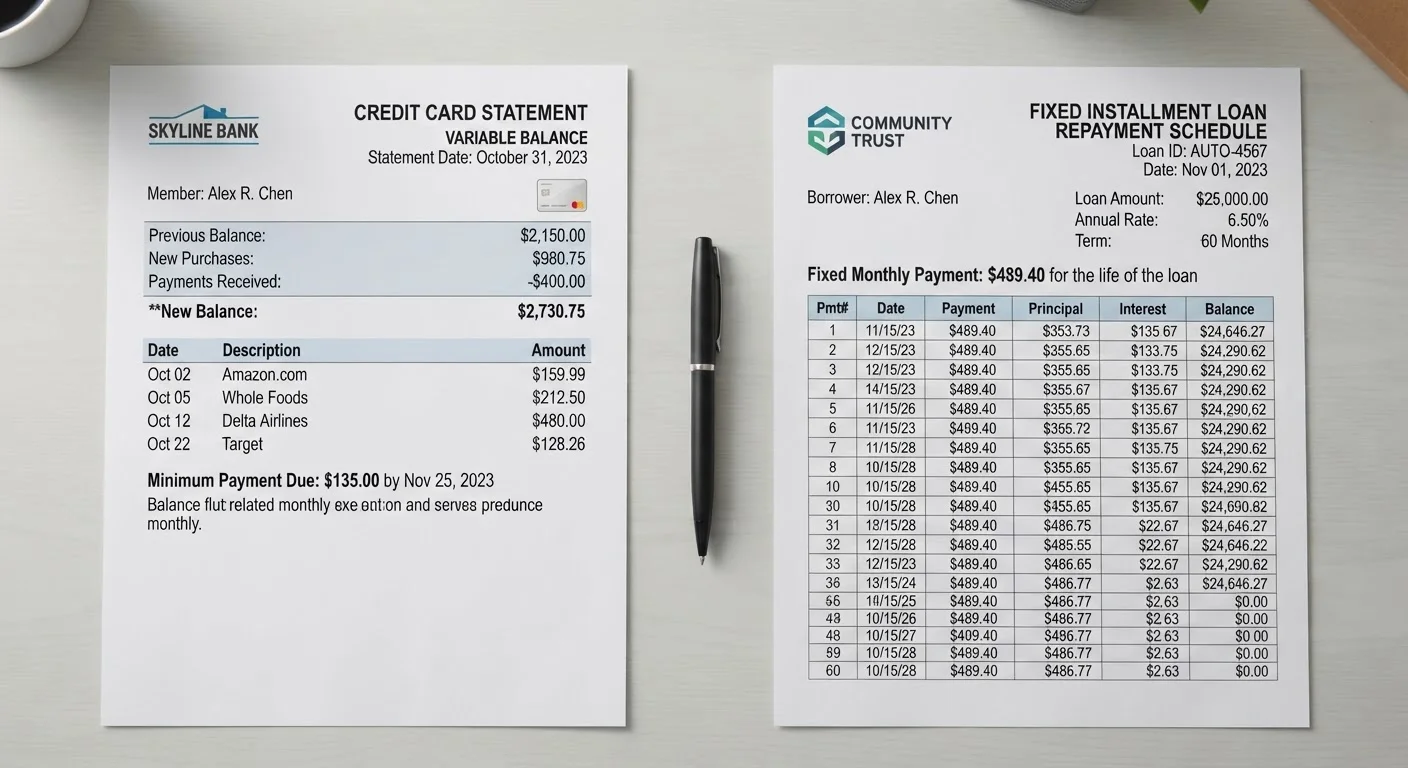
Photo credit: ExplorerGrid.com | Endless Grid Of Factual Content
In this article
Credit cards and auto loans affect your credit score in distinct ways. Understand the difference and what it means for your financial standing.
Key Takeaways
- Revolving debt has a flexible balance and credit limit; installment debt has a fixed loan amount and payment schedule.
- Credit utilization ratio — a major scoring factor — applies only to revolving accounts, not installment loans.
- Having both debt types in your credit mix can modestly strengthen your credit profile over time.
- On-time payments matter more than debt type for your overall credit score.
- Carrying high revolving balances relative to your credit limit tends to hurt your score more than carrying an installment balance.
The Core Difference: How Each Type of Debt Works
Before diving into credit scoring mechanics, it helps to understand what distinguishes these two debt categories at a structural level. For a plain-language primer on foundational concepts, see our introductory guide to debt and credit.
Revolving debt gives you access to a credit limit you can borrow against, repay, and borrow again — repeatedly, without the account closing. Credit cards are the most common example. Your required payment fluctuates month to month based on your balance, and you can choose to carry a balance (though doing so typically means paying interest) or pay in full.
Installment debt works differently. You borrow a fixed sum, agree to a repayment schedule — usually equal monthly payments over a set number of months or years — and the account closes when the loan is paid off. Mortgages, auto loans, student loans, and personal loans all fall into this category.
| Criterion | Revolving Debt | Installment Debt |
|---|---|---|
| Common examples | Credit cards, lines of credit | Mortgages, auto loans, student loans |
| Loan amount | Flexible; borrow up to credit limit | Fixed sum borrowed upfront |
| Monthly payment | Varies with balance | Fixed amount each period |
| Account lifecycle | Stays open; revolves indefinitely | Closes when loan is paid off |
| Affects utilization ratio | Yes — directly | No |
| Contributes to credit mix | Yes | Yes |
| Payment history reported | Yes — monthly | Yes — monthly |
| Interest accrual risk | High if balance carried | Fixed rate baked into schedule |
These structural differences determine how each debt type is interpreted by credit scoring models.
How Each Type Affects Your Credit Score
Credit scoring models — including the widely used FICO® Score — evaluate several factors. Payment history (whether you pay on time) and amounts owed together account for roughly two-thirds of a typical FICO® Score. Debt type sits at the center of both.
Credit Utilization: The Revolving-Specific Factor
Credit utilization ratio — the percentage of your total revolving credit limit you're currently using — applies exclusively to revolving accounts. If you have $10,000 in total credit card limits and carry a $3,000 balance, your utilization is 30%. Most scoring guidance suggests keeping utilization below 30%, and below 10% is associated with strong scores. Installment loan balances do not factor into this ratio. Paying down a credit card balance therefore tends to move your score faster than making extra payments on a car loan.
Payment History: Equal-Opportunity Impact
A missed or late payment damages your score regardless of whether the account is revolving or installment. Because payment history is the single largest scoring factor, this is the one area where both debt types carry identical weight. See our article on habits that quietly damage your credit for a broader look at overlooked missteps.
Credit Mix: A Modest but Real Benefit
Scoring models allocate a small portion of your score — roughly 10% in the FICO® model — to credit mix, meaning the variety of account types in your history. Holding both a revolving account and an installment account in good standing can provide a modest positive signal. That said, opening a new account solely to improve your mix rarely makes financial sense; the benefit is incremental and comes with a hard inquiry.
~30%
Utilization ratio associated with score risk
FICO® guidance generally associates credit utilization above 30% with increased scoring risk, though lower is better.
35%
Share of FICO® Score from payment history
According to FICO®, payment history is the single largest factor in a standard FICO® Score calculation.
10%
Score weight given to credit mix
FICO® allocates approximately 10% of its score calculation to the variety of account types in a consumer's credit file.
Practical Implications for Managing Both Debt Types
Understanding the mechanics of each debt type leads to actionable choices. Here are the most important levers to manage:
- Prioritize revolving balance reduction first. Because utilization feeds directly into your score in real time (balances are typically reported monthly), reducing credit card balances produces faster score improvement than accelerating installment payoff.
- Never miss a payment on either type. A 30-day late payment can remain on your credit report for up to seven years and affects both revolving and installment accounts equally.
- Avoid closing old revolving accounts without reason. Closing a credit card reduces your total available credit limit, which can raise your utilization ratio even if your balances stay the same. Our piece on credit-damaging moves to avoid explains the mechanics in detail.
- Know what lenders weigh beyond the score. Your debt-to-income ratio — total monthly debt payments divided by gross monthly income — is evaluated separately from your credit score. High installment loan payments can strain this ratio even if your score looks healthy. See what lenders examine beyond the credit score for more context.
If you're managing multiple debts simultaneously, understanding how to sequence payoff can be just as important as understanding how each type is scored. Our comparison of the debt avalanche and debt snowball methods walks through both approaches side by side.
This article is for general informational purposes only and does not constitute personalized financial or credit advice. Consult a licensed financial professional before making decisions based on your specific situation.

Author
Personal Finance Editorial Team
Personal Finance Editorial Team is the collective byline for our editorial team and contributor network. Articles published under this byline or an editorial pen name are researched, written, and reviewed according to our editorial standards for clarity, consistency, and independence before publication.
View all articles →