
How Home Ventilation Actually Works — and Why It Matters
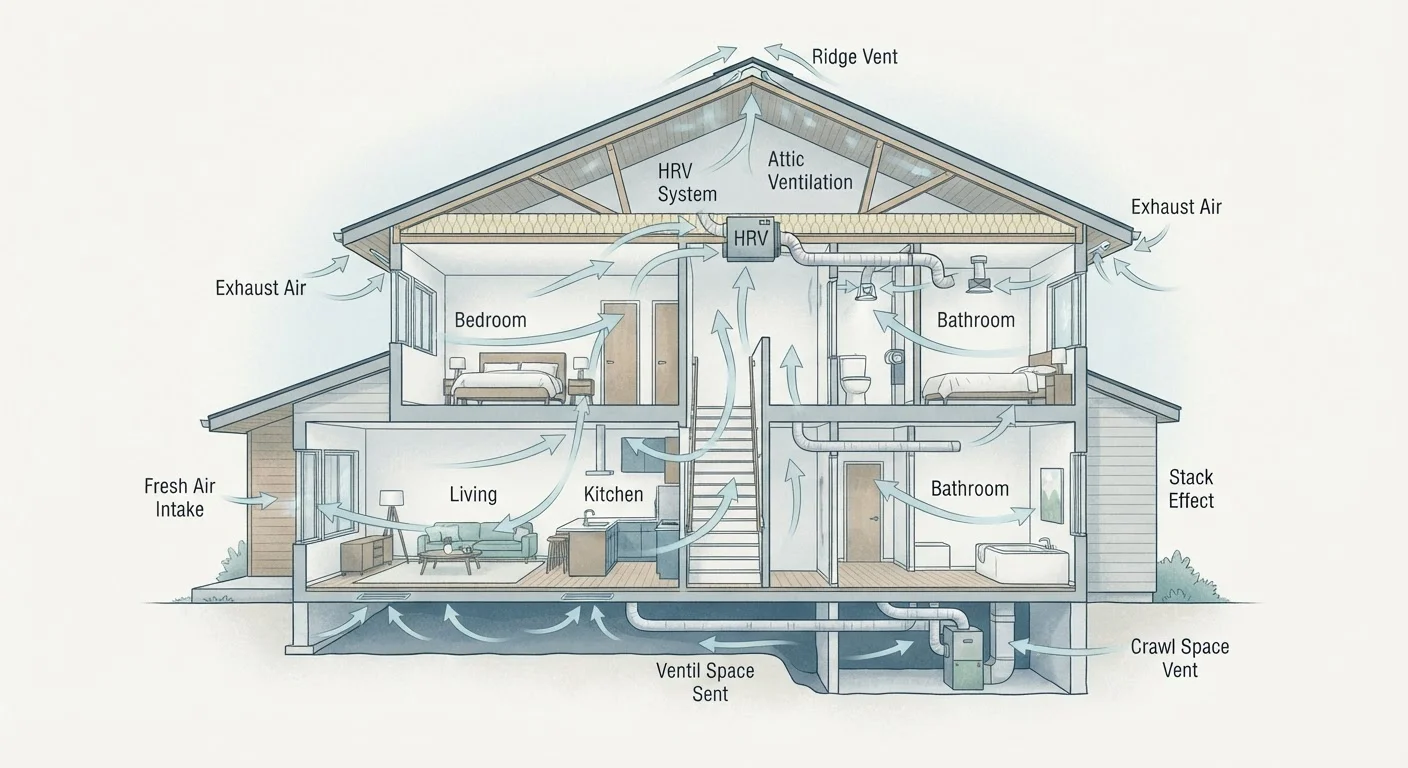
Photo credit: ExplorerGrid.com | Endless Grid Of Factual Content
In this article
Poor ventilation drives up energy costs, causes moisture damage, and affects air quality. This explainer covers the basics every homeowner should know.
Key Takeaways
- Ventilation controls moisture, air quality, and indoor temperature simultaneously.
- There are three main types: natural, spot (exhaust), and whole-house mechanical ventilation.
- Too little ventilation causes mold and poor air quality; too much wastes energy.
- Attics and crawl spaces need ventilation distinct from the living areas of a home.
- Seasonal changes affect how much ventilation your home needs and how systems perform.
The Three Types of Home Ventilation
Understanding how ventilation works starts with recognizing that there is no single system — most homes rely on a combination of three approaches working together.
Natural Ventilation
Natural ventilation relies on pressure differences and temperature gradients to move air through openings in the building envelope — windows, doors, vents, and even small gaps. Warm air rises and escapes through higher openings while cooler air enters below. This process, called the stack effect, happens in every home, whether you intend it or not. It's most effective in milder climates and during transitional seasons.
Spot (Exhaust) Ventilation
Spot ventilation removes moisture and pollutants at the source. Bathroom exhaust fans, range hoods, and dryer vents are all forms of spot ventilation. They work by depressurizing a small area and pulling air out. Because these fans create negative pressure, they also draw replacement air in from elsewhere — ideally through a controlled path, though in practice air often infiltrates through cracks and gaps.
Whole-House Mechanical Ventilation
Whole-house systems provide consistent, controlled air exchange across the entire living area. Common configurations include supply-only systems (which push fresh air in), exhaust-only systems (which pull air out), balanced systems (which do both simultaneously), and energy recovery ventilators (ERVs) or heat recovery ventilators (HRVs), which transfer heat and sometimes moisture between incoming and outgoing airstreams to minimize energy loss. For more on how ventilation intersects with energy efficiency, see energy efficiency upgrades that change how a home feels.
HRVs and ERVs: Worth Knowing About
Heat recovery ventilators (HRVs) and energy recovery ventilators (ERVs) are increasingly common in tightly built homes. An HRV transfers heat between outgoing and incoming airstreams, reducing heating costs in cold climates. An ERV also transfers moisture, which helps maintain comfortable humidity levels year-round. If you are building new or undertaking a major renovation, these systems are worth discussing with your contractor.
Why Ventilation Matters for Moisture and Air Quality
The most immediate consequence of poor ventilation is moisture accumulation. Cooking, bathing, breathing, and even houseplants release water vapor into indoor air. Without adequate air exchange, that moisture condenses on cool surfaces — inside wall cavities, on window frames, in attic sheathing — creating the conditions for mold growth, wood rot, and structural damage over time.
Air quality is the second major concern. Modern homes are built tightly for energy efficiency, which is valuable — but tight construction without intentional ventilation traps a range of indoor pollutants: volatile organic compounds (VOCs) from paints and furniture, carbon dioxide from occupants, combustion byproducts from gas appliances, and particulates tracked in from outside. The EPA has noted that indoor air can be significantly more polluted than outdoor air in many US homes.
Properly ventilating your home is also directly tied to how your HVAC system performs. Filters, for instance, only work well when airflow is balanced — learn more in our guide to what homeowners get wrong about HVAC filter changes.
2–5×
Indoor vs. outdoor air pollution ratio
The US Environmental Protection Agency estimates that indoor air pollutant levels are often 2 to 5 times higher than outdoor levels, and can be up to 100 times higher in some cases.
~50%
Home energy use from heating and cooling
According to the US Energy Information Administration, heating and cooling together account for roughly half of energy use in a typical US home — ventilation directly influences how efficiently these systems operate.
0.35 ACH
Minimum recommended air changes per hour
ASHRAE Standard 62.2 sets a widely referenced minimum of 0.35 air changes per hour for residential spaces, though specific requirements vary by home size and occupancy.
Attics, Crawl Spaces, and Why They Need Separate Attention
Many homeowners assume ventilation is only about the rooms they live in. In reality, the unconditioned spaces in a home — attics and crawl spaces — have their own ventilation requirements, and neglecting them leads to some of the most expensive repairs homeowners face.
Attic Ventilation
An attic needs to breathe year-round. In summer, trapped heat can reach extreme temperatures, accelerating shingle deterioration and driving heat into the living space below. In winter, warm moist air that escapes from the living area into the attic can condense on cold roof sheathing, causing rot and mold. A properly ventilated attic maintains airflow from soffit (intake) vents near the eaves to ridge or gable (exhaust) vents near the peak. This system works passively without fans in most climates. Note that attic ventilation interacts closely with insulation — see common attic insulation misconceptions for more detail on how they work together.
Crawl Space Ventilation
Crawl spaces below homes are prone to ground moisture and condensation. Depending on your climate and foundation design, crawl spaces may be vented to the outside or sealed and conditioned — each approach has specific requirements. An unvented crawl space with inadequate moisture control is a common source of musty odors and subfloor damage. Consult a qualified contractor to determine the right approach for your region and existing foundation type.
Seasonal Considerations and Simple Maintenance Habits
Ventilation needs shift with the seasons, and staying ahead of those changes prevents most of the problems associated with poor air exchange.
- Spring and fall: Ideal seasons for natural ventilation. Open windows strategically — cross-ventilate by opening windows on opposite sides of the home to create a consistent airflow path.
- Summer: Run exhaust fans during cooking and bathing. If you use air conditioning, keep the home moderately sealed to retain conditioned air, but ensure mechanical ventilation is functioning.
- Winter: Run bathroom and kitchen fans consistently to remove moisture. Check that exhaust fan terminations are clear of snow and ice at the exterior wall or roof cap.
On the maintenance side, a few straightforward habits make a measurable difference: clean or replace exhaust fan grilles annually, verify that outdoor vent terminations are unobstructed, and check attic and crawl space vents each spring and fall. These tasks take minutes but protect against damage that can cost thousands. For a broader framework, our complete home maintenance resource covers how ventilation fits into your full seasonal schedule.
Frequently Asked Questions

Author
Home & Garden Editorial Team
Home & Garden Editorial Team is the collective byline for our editorial team and contributor network. Articles published under this byline or an editorial pen name are researched, written, and reviewed according to our editorial standards for clarity, consistency, and independence before publication.
View all articles →