
Training Collars Explained: What Each Type Does and When It's Actually Used
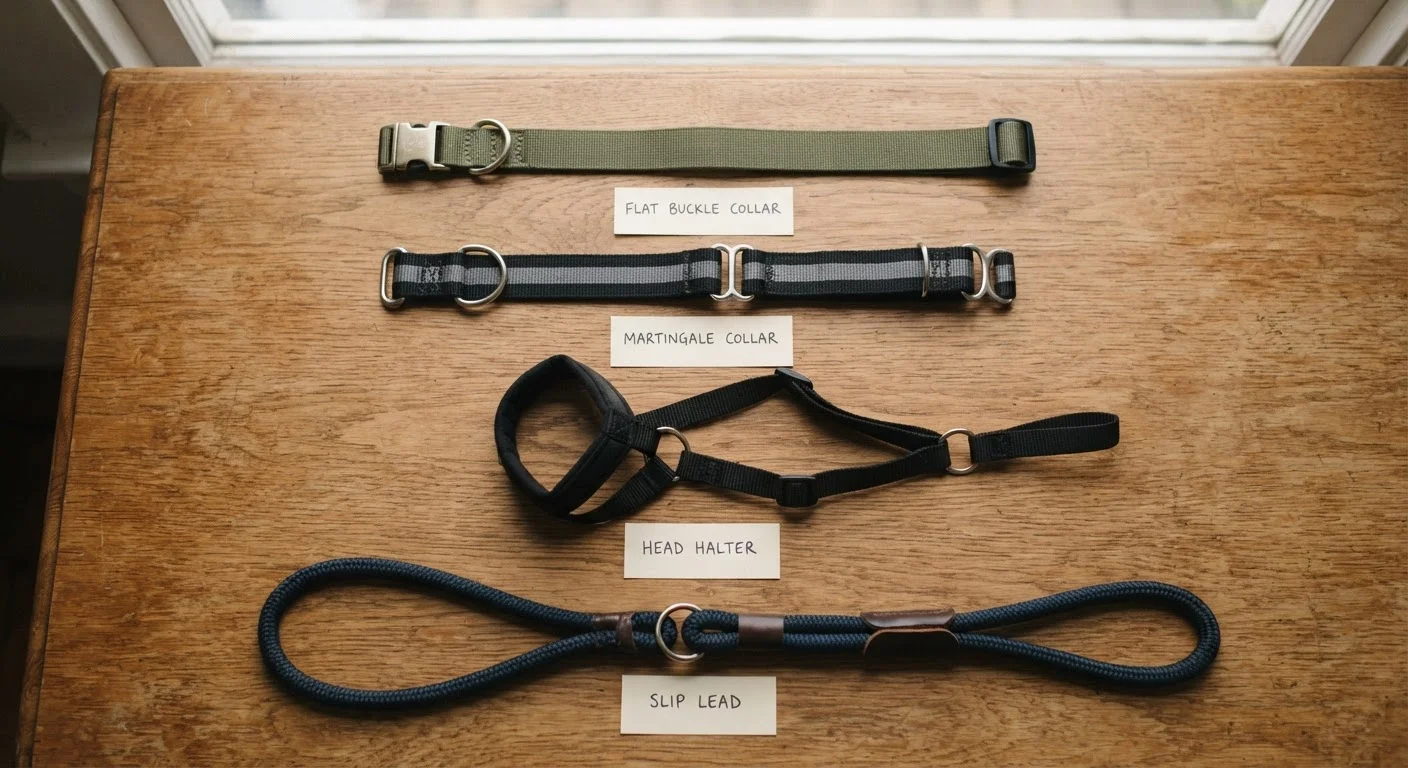
Photo credit: ExplorerGrid.com | Endless Grid Of Factual Content
In this article
From flat collars to head halters, this reference breaks down how each training collar works and the contexts in which trainers use them.
Why Collar Type Matters in Training
Not all training collars function the same way, and choosing the wrong one for a given dog or situation can reduce effectiveness — or cause harm. Collars range from purely mechanical management tools (a flat collar that simply holds an ID tag) to equipment that applies physical pressure to redirect behavior. Understanding how each type works mechanically is the foundation for making an informed choice.
This reference covers the most common collar types trainers and veterinary behaviorists discuss, explaining the mechanism behind each, the contexts in which they are typically used, and the considerations every owner should weigh. For a broader look at how training method philosophy shapes equipment choices, see our comparison of reward-based and correction-based training.
Collar-by-Collar Breakdown
Flat Buckle Collar
How it works: A fixed-width band that fastens around the neck at a set size. Applies no automatic pressure — it simply provides an attachment point for a leash or tags.
Best used for: Everyday wear, ID tags, and dogs that already walk calmly on leash. Not a training tool in itself, but the default starting point for puppies and well-mannered adult dogs.
Martingale Collar
How it works: Features a limited-slip loop: when the dog pulls, the collar tightens only to a set maximum diameter, preventing the dog from backing out. It releases fully when leash tension is removed.
Best used for: Sighthound breeds with narrow heads (whippets, greyhounds), dogs prone to slipping collars, and training contexts where brief, self-correcting feedback is acceptable. Widely considered lower-risk than traditional choke chains because tightening is mechanically limited.
Head Halter (Head Collar)
How it works: Loops around the muzzle and behind the ears. Leash attaches under the chin, so pulling redirects the dog's nose — and therefore body — back toward the handler rather than forward.
Best used for: Strong pullers, reactive dogs, and handlers who cannot physically manage a large dog on a standard collar. Does not restrict breathing or biting, but requires a careful acclimation period; many dogs resist the sensation initially. Consult a certified trainer before introducing one to a highly reactive dog.
Front-Clip Harness
How it works: Technically a harness, not a collar, but frequently discussed alongside collar options. The leash attaches at the chest, steering the dog sideways when it pulls forward — reducing forward momentum without neck pressure.
Best used for: Pulling management on dogs with tracheal sensitivity (brachycephalic breeds, small dogs), puppies in early leash training, and owners committed to force-free methods. Pairs well with marker-based training; see clicker vs. verbal marker training for compatible communication techniques.
Slip Lead / Choke Chain
How it works: A loop that tightens without limit when tension is applied, releasing when tension drops. Choke chains are metal; slip leads are typically nylon or leather.
When they appear: Slip leads are standard in veterinary and shelter settings for quick, hands-free control during handling — not as ongoing training tools. Choke chains were once common in obedience training but have largely been replaced by equipment with less injury potential. Research by veterinary organizations, including guidance published by the American Veterinary Society of Animal Behavior (AVSAB), consistently notes risks of tracheal, esophageal, and ocular injury with improper use.
Prong (Pinch) Collar
How it works: Metal links with blunted inward-facing prongs that apply distributed lateral pressure around the neck when the leash tightens.
When they appear: Used by some trainers for suppressing strong pulling or reactive lunging in large, powerful dogs when other methods have not succeeded. Considered an aversive tool; AVSAB and many professional organizations recommend exhausting positive reinforcement-based alternatives first. Requires proper fit and experienced guidance — misuse carries injury risk.
Electronic (E-Collar / Remote Collar)
How it works: Delivers a remote-controlled stimulus — typically a vibration, tone, or adjustable static stimulation — via a receiver worn at the neck. Modern units operate across a wide range of intensity levels.
When they appear: Used in some professional contexts for off-leash reliability at distance (hunting dogs, search-and-rescue) and for dogs with certain behavioral histories. Highly technique-dependent; misapplication is associated with increased fear and aggression responses. Not appropriate as a first-line tool, and should only be used under the supervision of a certified professional. This is a topic where owner consultation with a veterinary behaviorist or certified applied animal behaviorist (CAAB) is strongly recommended before proceeding.
Aversive
In animal behavior science, an aversive stimulus is something the animal finds unpleasant and will work to avoid. Training tools or methods that rely on aversives carry a higher risk of fear- or pain-based side effects if misapplied.
Limited-Slip
A collar design that tightens under tension only up to a pre-set maximum diameter, then stops. This distinguishes martingale collars from choke chains, which have no upper tightening limit.
Head Halter
A management collar that loops around a dog's muzzle and head. Leash pressure redirects the dog's nose rather than applying force to the trachea. Does not function as a muzzle.
AVSAB
The American Veterinary Society of Animal Behavior — a professional organization of veterinarians and PhD animal behaviorists that publishes position statements on training methods and equipment.
CAAB
Certified Applied Animal Behaviorist — a credential granted by the Animal Behavior Society to individuals with advanced graduate training in animal behavior. CAABs are among the most qualified professionals for complex behavioral cases.
Marker Training
A training approach that uses a precise signal — a click or verbal word — to mark the exact moment a correct behavior occurs, followed by a reward. Works independently of collar type.
Matching Equipment to Your Dog's Situation
No collar type is universally right or wrong — context determines appropriateness. Key variables include the dog's age, physical health (cervical or tracheal conditions rule out neck pressure entirely), prior training history, and the specific behavior being addressed.
Rescue dogs often present unique considerations: stress responses and trust deficits can make aversive equipment counterproductive even when it might be tolerated by a confident pet-store puppy. Training an adult rescue dog requires particular attention to how equipment is introduced.
As a practical rule endorsed by major veterinary behavior organizations: start with the least aversive option that can realistically manage the behavior, and layer in professional guidance before moving to more restrictive tools. If a training approach requires escalating equipment intensity to maintain results, that is a signal to reassess the method, not increase the aversive. Working with a qualified trainer in the right format can make equipment decisions much clearer.
This article is for general informational purposes only and is not a substitute for professional veterinary or certified animal behaviorist advice. Always consult a qualified professional before using training equipment that applies physical pressure, particularly for dogs with health conditions, behavioral concerns, or a history of trauma.

Author
Pets & Animals Editorial Team
Pets & Animals Editorial Team is the collective byline for our editorial team and contributor network. Articles published under this byline or an editorial pen name are researched, written, and reviewed according to our editorial standards for clarity, consistency, and independence before publication.
View all articles →