
Soil Amendments Explained: What Compost, Perlite, and Lime Actually Do
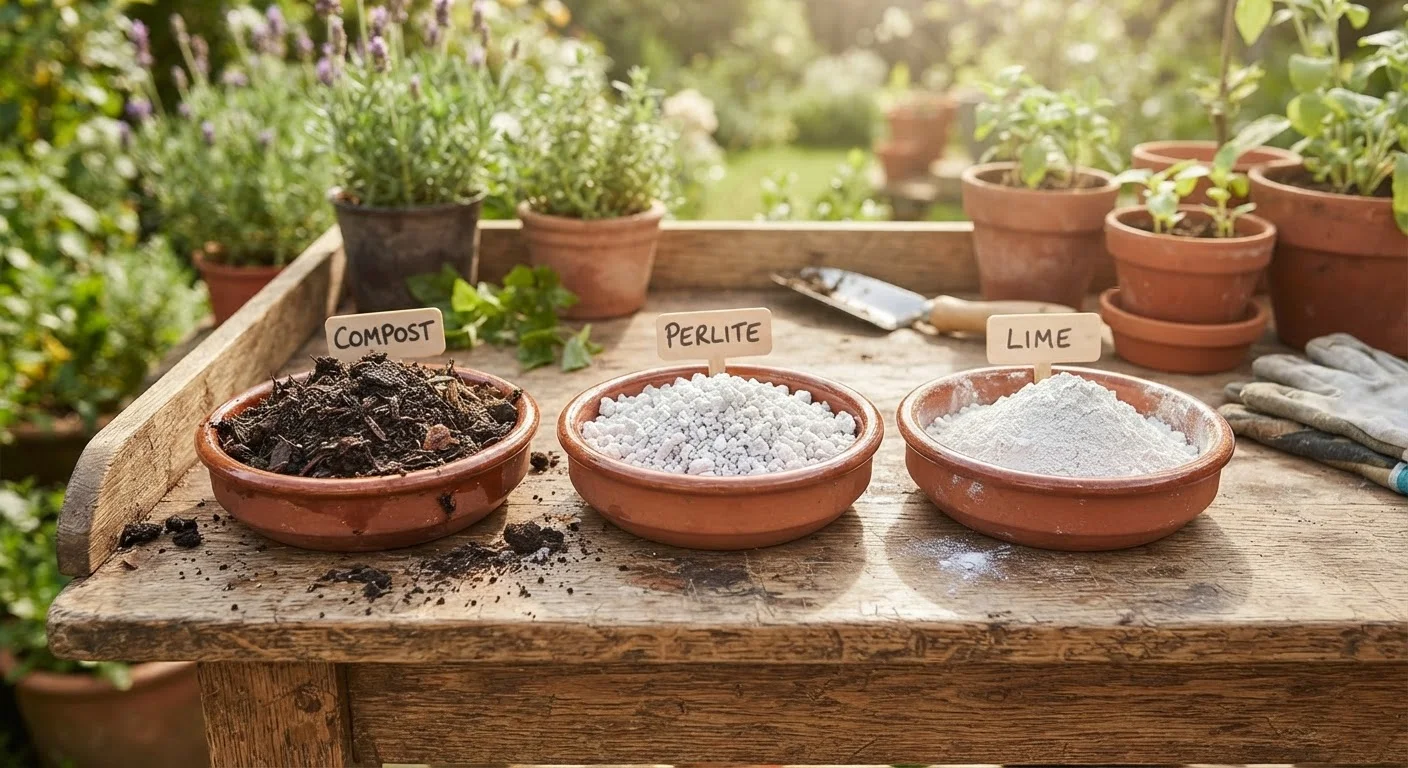
Photo credit: ExplorerGrid.com | Endless Grid Of Factual Content
In this article
Understand what common soil amendments do, when each one is useful, and how they interact with your existing garden soil.
Key Takeaways
- Compost improves soil structure, adds organic matter, and feeds beneficial soil microbes.
- Perlite increases drainage and aeration — it does not add nutrients.
- Lime raises soil pH, making acidic soils more hospitable to most vegetables and turf grass.
- Testing your soil before amending prevents over-correcting and wasting materials.
- Amendments work best when matched to your specific soil type and plant needs.
Why Soil Amendments Matter More Than Fertilizer Alone
Many gardeners reach for fertilizer when plants struggle, but nutrients can only do so much if the soil itself is working against you. Compacted clay repels roots even in nutrient-rich conditions. Sandy soil drains so fast that water and dissolved nutrients run straight through before plants can absorb them. Soil that's too acidic or too alkaline locks up nutrients chemically, making them unavailable no matter how much fertilizer you apply.
Amendments address these foundational problems. They change the physical structure, chemistry, or biology of your soil — creating conditions where plant roots can actually access what they need. Whether you're working a raised bed or an in-ground plot, understanding what each amendment does helps you apply the right fix rather than a generic one. For a broader look at how soil management differs between setups, see raised bed vs. in-ground gardening.
Test Before You Amend
Before purchasing any amendment, invest in a basic soil test. Most county cooperative extension offices offer testing at low or no cost, and results typically include specific recommendations. Amending without data often means spending money on materials your soil doesn't need — or, worse, pushing conditions further out of balance.
Compost: The All-Purpose Soil Builder
Finished compost — decomposed organic matter from plant scraps, yard waste, and food leftovers — is the most versatile amendment available to home gardeners. It improves nearly every soil type: in clay soils, it breaks up compaction and improves drainage; in sandy soils, it binds particles together and improves moisture retention.
Beyond structure, compost feeds the microbial ecosystem that makes healthy soil function. Bacteria, fungi, and earthworms all thrive in compost-rich soil, and their activity continuously releases nutrients in plant-available forms. Compost also adds a modest but broad spectrum of nutrients, making it both an amendment and a gentle, slow-release fertilizer.
Apply 1–2 inches of finished compost to garden beds and work it into the top 6–8 inches of soil. For beds that were already amended last season, a lighter annual top-dressing maintains organic matter levels without over-building. If you want to produce compost at home rather than buy it, our guide to composting at home walks through the full process.
~5%
Ideal organic matter content in productive garden soil
Many US agricultural soils contain 1–3% organic matter; regular compost application is one of the primary ways gardeners work toward higher levels over time.
6.0–7.0
Optimal soil pH range for most vegetables
Outside this range, key nutrients including phosphorus, calcium, and magnesium become significantly less available to plant roots, according to university extension resources.
100+ lbs
Lime potentially needed per 1,000 sq ft to correct highly acidic soil
Exact rates vary widely by soil type and current pH; a soil test is required to determine the right application rate for a specific site.
Perlite: Solving Drainage and Compaction Problems
Perlite is a mined volcanic glass that is heated until it expands into lightweight, porous white granules. It contributes no nutrients and has a neutral pH, but it does one thing exceptionally well: it creates permanent air pockets in dense or compacted soil.
In heavy clay or tightly packed garden beds, perlite prevents waterlogging by giving water a pathway to drain and allowing oxygen to reach root zones. This matters because most plant roots need air as much as moisture — waterlogged roots quickly become oxygen-starved and susceptible to rot.
Perlite is particularly useful in container mixes, where drainage is critical and weight matters. A typical ratio for container gardens is one part perlite to three or four parts potting mix, though this varies by plant type. In in-ground beds, perlite works best when mixed into the top 10–12 inches rather than applied as a surface layer, which would have little effect on deeper root zones.
One thing to note: perlite's fine dust can be an irritant when dry. Lightly misting the bag before scooping limits airborne particles during application.
Lime: Adjusting pH for Plant-Ready Soil
Soil pH — measured on a scale from 0 to 14 — determines how available nutrients are to plants. Most vegetables, turf grasses, and many flowering plants prefer a pH between 6.0 and 7.0. When soil is too acidic (below 6.0), nutrients like calcium, magnesium, and phosphorus become chemically bound and unavailable, even when physically present in the soil.
Lime — most commonly ground agricultural limestone — neutralizes excess acidity by introducing calcium carbonate, which reacts with hydrogen ions in the soil to gradually raise pH. It works slowly: results may take several months to fully register, which is why fall application is often recommended so soils are ready by spring planting. For a complete fall soil prep checklist, see fall garden prep tasks.
The amount of lime needed depends on your current pH, your target pH, and your soil type. Clay soils require more lime to shift pH than sandy soils because they have greater buffering capacity. A soil test — available through many university extension programs or garden centers — is essential before applying lime. Over-liming raises pH too high, which causes its own set of nutrient lockout problems.
Sulfur Lowers pH — Lime Raises It
Lime is the go-to amendment for acidic soil, but the opposite problem — soil that's too alkaline — requires a different approach. Elemental sulfur or acidifying fertilizers are commonly used to lower pH for acid-loving plants like blueberries or rhododendrons. Never apply lime to soil that's already at or above your target pH.
Matching the Right Amendment to Your Soil's Actual Needs
The most common mistake gardeners make with amendments is applying them by assumption rather than diagnosis. Adding lime to soil that's already at a neutral pH, for example, can push it alkaline and cause iron or manganese deficiency in plants that need slightly acidic conditions — blueberries and azaleas being classic examples.
A basic soil test removes the guesswork. It gives you pH, and often organic matter percentage and key nutrient levels, so you can target only what's actually deficient. Many US county cooperative extension offices offer low-cost soil testing, and results typically include specific amendment recommendations for your region's soil type.
For gardeners who maintain ground covers or lawn areas with patchy or compacted zones, understanding your soil's baseline helps explain persistent performance problems. See our overview of ground cover options for struggling lawn areas for context on how soil quality affects plant choice in those spots.
Once you have test results, amendments can be layered strategically: compost every season to maintain organic matter, perlite worked in when drainage is a structural problem, and lime only when pH is measurably low and needs correction. This targeted approach gets better results with less material and less risk of unintended consequences.
Frequently Asked Questions

Author
Home & Garden Editorial Team
Home & Garden Editorial Team is the collective byline for our editorial team and contributor network. Articles published under this byline or an editorial pen name are researched, written, and reviewed according to our editorial standards for clarity, consistency, and independence before publication.
View all articles →